Reproductive & Sexual Health System

System Overview Reproductive Biology. Investigated From Hypothalamus to Receptor.
The Reproductive & Sexual Health System encompasses the molecular and neuroendocrine networks that govern reproductive axis regulation, gonadotropin secretion, sexual desire, vascular function in erectile and arousal physiology, and the neurobiology of social bonding. Research in this domain spans from the uppermost hypothalamic regulatory nodes — where neuropeptides govern the pulsatile release of gonadotropin-releasing hormone (GnRH) — to the peripheral vascular and smooth muscle responses that constitute the physiological substrate of sexual function, and further to the central nervous system circuits that encode desire, motivation, and pair bonding.


Core Mechanisms Central Mechanisms
4 cards — ruby red accent. Layout: stacked vertical on mobile, 2-column grid on desktop.
Kisspeptin neurons in the hypothalamic arcuate nucleus function as the upstream pulse generator for GnRH secretion, acting through the KISS1R receptor to trigger the pulsatile LH and FSH release that governs gonadal steroidogenesis and gametogenesis. Research examines how kisspeptin isoforms (kisspeptin-10, kisspeptin-54), administration routes, and dose regimens influence HPG axis dynamics in models of reproductive dysfunction.
The melanocortin system, acting through MC3R and MC4R receptors in the hypothalamus and limbic system, regulates the neural circuitry of sexual desire upstream of vascular response. Research documents how melanocortin receptor agonism increases dopamine release in the medial preoptic area and activates paraventricular nucleus (PVN) circuits involved in sexual motivation — a central, neurogenic mechanism distinct from peripheral hemodynamic approaches.
Penile erection and female sexual arousal involve coordinated relaxation of vascular smooth muscle mediated in part by NANC neurotransmitters — a class that includes VIP as a documented neuropeptide in cavernous tissue. Research investigates how VIP-mediated cAMP signaling in corpus cavernosum smooth muscle contributes to the hemodynamic events of erection, operating in a mechanistic context distinct from NO/PDE5 pathways.
Oxytocin, synthesized in hypothalamic paraventricular and supraoptic nuclei, acts through OXTR receptors in the nucleus accumbens, amygdala, and prefrontal cortex to modulate dopaminergic reward signaling, social recognition, and the formation of pair bonds. Research in animal models and human neuroimaging studies investigates how oxytocin receptor distribution patterns correlate with the behavioral and neural substrates of sexual satisfaction and attachment.

Related Compounds Research Compounds in This System
Horizontal card grid — one card per compound. CTA: View Molecule per card. Ruby red system accent.
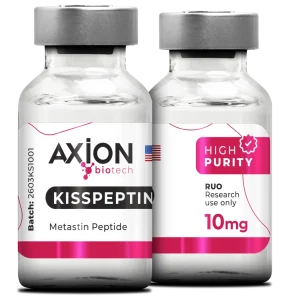
The principal upstream activator of the GnRH pulse generator, investigated across translational research contexts involving HPG axis regulation, hypothalamic amenorrhea, and hypogonadotropic hypogonadism.CTA: View Molecule
View Product
Pathways & Biological Context Key Research Pathways
2-column list on desktop. Ruby red accent on section header.
- KISS1 / KISS1R pathway — upstream regulation of GnRH pulsatility in the hypothalamic arcuate nucleus
- KNDy (Kisspeptin-Neurokinin B-Dynorphin) neuron network — GnRH pulse generator and sex steroid feedback
- GnRH / LH / FSH axis — pituitary gonadotropic axis and gonadal function
- MC3R / MC4R (melanocortin receptors) — central signaling of desire and sexual arousal
- Dopamine / mesolimbic reward pathway — sexual motivation mediated through MC4R agonism
- VIP / VPAC receptors / cAMP — cavernous smooth muscle relaxation (NANC mechanism)
- Oxytocin receptor (OXTR) / nucleus accumbens signaling — social bonding and sexual behavior
- HPG axis (Hypothalamic-Pituitary-Gonadal) — integrated gonadal regulation through steroid feedback

Related Articles - Research Library Explore the Science Behind This System
The Research Library provides in-depth editorial coverage of the mechanisms, evidence, and investigative directions relevant to this system. Each article connects to one or more related compounds in the AXION catalog.
All compounds listed in this system are classified as Research Use Only (RUO). They are not approved for therapeutic, diagnostic, or clinical use in humans or animals. AXION does not make therapeutic claims of any kind. Access to compounds is available through AXION's structured access model.