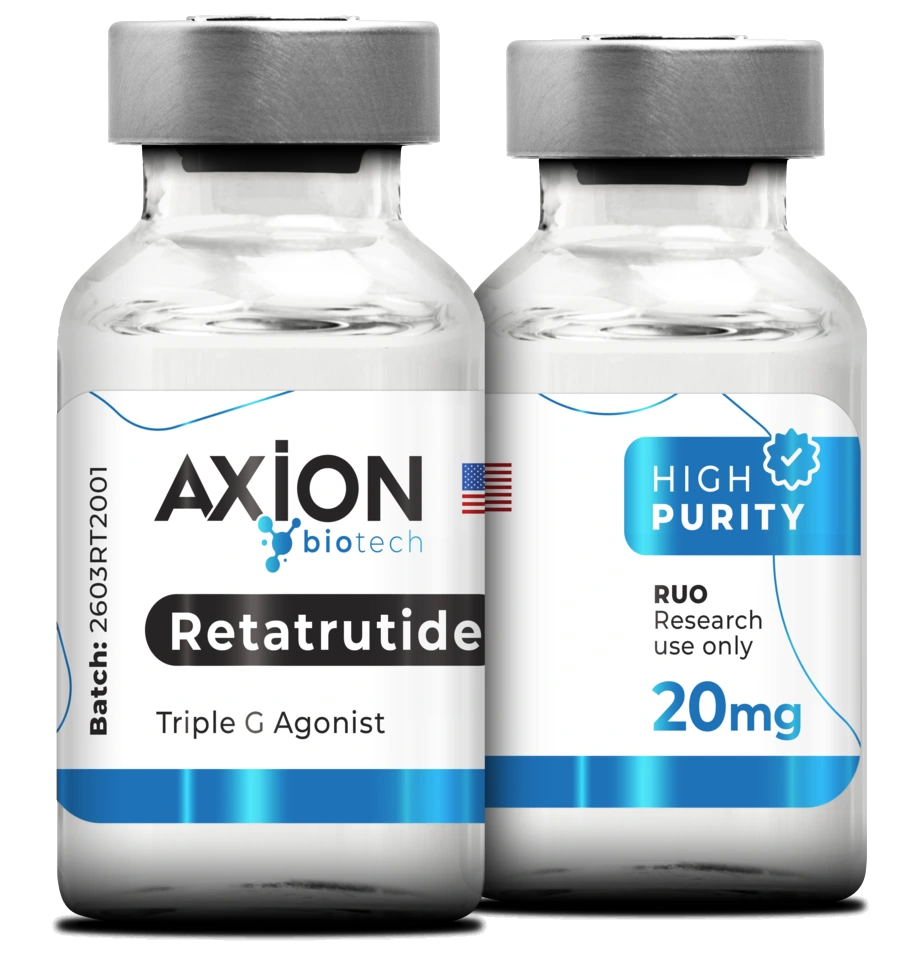
Retatrutida
Access to the catalog is structured — not open by default.

Overview
Retatrutida (LY3437943) is a 39-amino acid synthetic peptide engineered to simultaneously activate three distinct hormonal receptors: GLP-1R (Glucagon-Like Peptide-1 Receptor), GIPR (Glucose-Dependent Insulinotropic Polypeptide Receptor), and GCGR (Glucagon Receptor). This triple receptor agonism positions it within AXION’s Metabolic Regulation System — a compound cluster organized around signaling pathways associated with glycemic homeostasis, energy partitioning, lipid metabolism, and appetite regulation.
The scientific rationale for triple agonism derives from the observation that each receptor contributes a distinct and complementary metabolic signal. GLP-1R activation modulates postprandial insulin secretion, delays gastric emptying, and engages central appetite circuits. GIPR activation potentiates insulin release in a glucose-dependent manner and is investigated for its role in lipid metabolism. GCGR activation — the mechanistic differentiator relative to earlier-generation dual agonists — is studied for its impact on hepatic energy expenditure and fatty acid oxidation.
Among the structural characteristics of retatrutida, two modifications are particularly relevant to research models. The inclusion of non-standard amino acids (Aib2, Aib20, αMeL13) confers resistance to DPP-4 enzymatic cleavage, extending metabolic stability. Conjugation of a C20 fatty diacid via Lys4 enables albumin binding, prolonging plasma half-life to approximately six days and enabling weekly dosing in clinical study designs.


Research Directions
The published literature on retatrutida spans in vitro receptor binding assays, preclinical rodent models, and multi-phase clinical investigation — an unusually broad evidence base for a compound not yet approved by any regulatory agency. Below is an overview of the principal research areas documented in the scientific literature.
- Triple receptor agonism pharmacology — differential potency profiling across GLP-1R, GIPR, and GCGR in cell-based and in vivo models
- Glycemic regulation and insulin secretion — glucose-dependent mechanisms in DM2 and normoglycemic models
- Body composition and energy expenditure — GCGR-mediated thermogenic and lipolytic signaling, hepatic fatty acid oxidation
- Hepatic steatosis research — MASLD and MASH models; hepatic fat reduction documented in Phase 2 clinical studies
Cardiometabolic markers — LDL-C reduction observed in clinical studies; putative PCSK9 pathway via GCGR (mechanism under investigation) - Structural pharmacology — role of Aib substitutions and C20 fatty diacid conjugation in DPP-4 resistance and albumin-mediated half-life extension
- Comparative pharmacology — positioning relative to GLP-1R mono-agonists and GLP-1R/GIPR dual agonists in metabolic research contexts
Postprandial insulin secretion modulation, gastric emptying delay, and central appetite circuit engagement via GLP-1 receptor. GLP-1R potency in retatrutida is clinically relevant but relatively lower than native GLP-1.
Enhanced potency at GIPR relative to endogenous GIP. Investigated as the primary pharmacological differentiator of retatrutida versus prior-generation agonists. Contributes to glucose-dependent insulin potentiation and lipid metabolism modulation.
Modest GCGR activation studied for its role in increasing energy expenditure, hepatic fatty acid oxidation, and lipolysis. Mechanistically distinct from GLP-1R and GIPR pathways; investigated as additive to dual agonism.
Reduction in LDL-cholesterol (~20%) observed in Phase 2 clinical studies. Hypothesis of PCSK9 degradation via GCGR activation is under investigation; mechanism not yet experimentally confirmed in humans.
GLP-1R and GIPR activation in hypothalamus and area postrema investigated for modulation of appetite-regulating neuroendocrine pathways.
Non-standard amino acid at position 2 (2-aminoisobutyric acid) confers resistance to DPP-4 enzymatic cleavage, extending plasma stability and enabling sustained receptor engagement.
Conjugation of a C20 diacid fatty moiety via Lys4 enables reversible albumin binding, extending plasma half-life to ~6 days and enabling weekly administration in clinical study designs.

Quality & Traceability
Every AXION compound is subject to analytical verification before release. Purity and traceability are not marketing attributes — they are part of the integrity of the research itself.
Learn more about our verification process: Quality & Testing

Explore the Science Behind This System
The Research Library provides in-depth editorial coverage of the mechanisms, evidence, and investigative directions relevant to this system. Each article connects to one or more related compounds in the AXION catalog.
Retatrutida (LY3437943) is supplied by AXION Biotech exclusively for research purposes. This compound is not approved by the FDA, ANVISA, EMA, or any regulatory agency for human or veterinary use. No therapeutic claims are made or implied. All scientific data referenced on this page derives from peer-reviewed publications, registered clinical trial results, and institutional press releases. Data from TRIUMPH-4 and TRANSCEND-T2D-1 are from Eli Lilly press communications and have not yet been fully published in peer-reviewed literature as of April 2026.