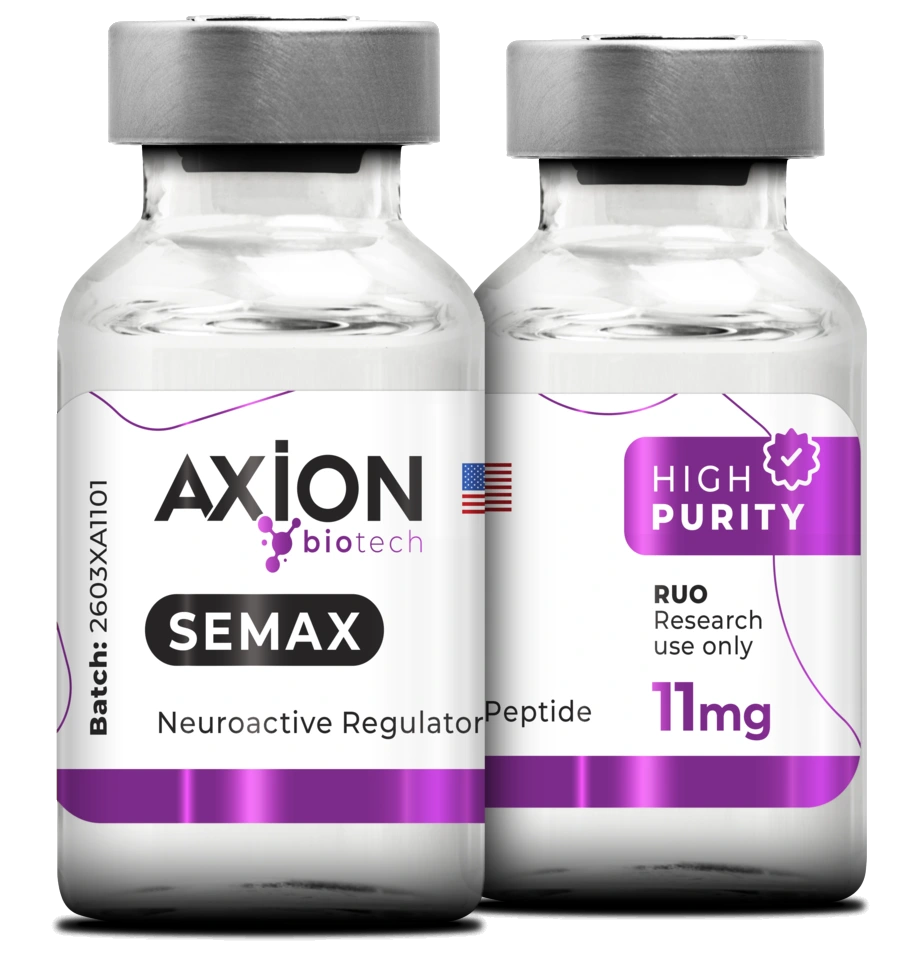
SEMAX
-
SystemNeural & Cognitive System
-
TypeSynthetic peptide — 7 amino acids
-
CAS80714-61-0
-
FormulaC₃₇H₅₁N₉O₁₀S
-
Mol. weight813.93 Da
-
FormLyophilized vial
-
Purity>98% by HPLC
-
StatusActive

SEMAX Overview
Semax is a synthetic heptapeptide developed at the Russian Academy of Sciences in the 1980s. Its sequence derives from the ACTH(4-10) fragment of corticotropin, with the addition of a C-terminal Pro-Gly-Pro (PGP) tripeptide that confers greater resistance to enzymatic degradation compared to the endogenous precursor. The name SEMAX is a Russian acronym for “SEven AMino aCids.” The compound exhibits no adrenocorticotropic hormonal activity, it does not stimulate cortisol production, but retains and amplifies the neurotrophic and nootropic properties of the parent molecule.
The scientific literature on Semax centers on its relationship with the BDNF/TrkB axis. BDNF (Brain-Derived Neurotrophic Factor) is among the most studied mediators of synaptic plasticity, the process by which neural connections reorganize in response to experience. Preclinical studies in rodents have investigated Semax’s capacity to modulate BDNF expression in the hippocampus, alongside effects on monoaminergic systems. Research in stroke models has also explored its potential neuroprotective properties.
Semax belongs to AXION’s Neural & Cognitive System, alongside Selank, Pinealon, and DSIP, compounds whose primary research context involves the central nervous system and neurotransmitter pathways. While Semax and Selank share a synthetic origin in Russian neuroscience, they operate through distinct mechanisms: Semax via the BDNF/TrkB axis and dopaminergic modulation; Selank via serotonergic and GABAergic signaling.

SEMAX Research Directions
The published literature on Semax spans several decades and multiple neurological contexts. Below is an overview of the principal research areas documented in preclinical and clinical studies.
- BDNF/TrkB axis modulation — neurotrophic signaling, synaptic plasticity, and hippocampal expression in rodent models
- Neuroprotection in cerebral ischemia models — focal ischemia (pMCAO/tMCAO), photothrombosis, and ischemia-reperfusion paradigms
- Monoaminergic system modulation — serotonergic (5-HIAA elevation) and dopaminergic potentiation in preclinical neurotransmitter studies
- Cognitive and learning models — conditioned avoidance paradigms, attention, and short-term memory in rodents and limited human studies
- Neuroinflammation and gene expression — transcriptomic changes in ischemic cortex; MMP-9/JNK/CREB pathway modulation
- Alzheimer’s disease models — anti-amyloidogenic potential and BDNF-related neuroprotection in transgenic murine models
- Parkinson’s disease — MPTP models in rodents; findings remain limited and conflicting
- Intranasal administration research — nasal route as a model for CNS peptide delivery, exploiting proximity to the olfactory pathway
- Melanocortin receptor interaction — competitive antagonism at MC4/MC5 receptors observed in vitro and in vivo
- Copper complexation and neurodegeneration — Semax/Cu²⁺ complexes investigated for anti-aggregation properties against β-amyloid in model membranes
Primary documented mechanism. A single intranasal dose (50 µg/kg) produced 1.4× increase in hippocampal BDNF protein, 3× increase in BDNF mRNA, 2× increase in TrkB mRNA, and 1.6× increase in TrkB phosphorylation (Dolotov et al., 2006). Downstream activation of MAPK/ERK and PI3K/Akt cascades is associated with neuronal survival and synaptic plasticity.
25% increase in striatal 5-HIAA tissue content; progressive elevation of extracellular 5-HIAA to ~180% within 1–4 hours post-administration (Eremin et al., 2005). Semax alone does not alter baseline dopamine levels but significantly potentiates dopaminergic responses when co-administered with d-amphetamine. Specific mechanism under investigation — indirect interaction via BDNF hypothesized.
Evidence of competitive antagonism at MC4 and MC5 receptors in vitro and in vivo. No antagonism observed at MC3. MC1/MC2 not investigated in this context. Functional significance in mediating cognitive and neuroprotective effects remains to be established.
Semax inhibits peptidolytic enzymes involved in enkephalin degradation (IC50 ≈ 10 µM), similar to Selank. Clinical relevance not established; may contribute to anxiolytic and mood-modulatory effects observed in preclinical studies.
In focal ischemia rat models, Semax broadly altered cortical transcriptome: upregulation of immune response genes, chemokines, and immunoglobulins; modulation of vascular stabilization genes; downregulation of MMP-9; modulation of JNK/CREB pathway (Filippenkov et al., 2021).
In vitro: Semax forms stable complexes with Cu²⁺. The Semax/Cu²⁺ complex demonstrated anti-aggregation properties against β-amyloid peptide in artificial membrane models. Research context: relevance to copper homeostasis dysfunction in neurodegenerative disease models.

SEMAX Quality & Traceability
Every AXION compound is subject to analytical verification before release. Purity and traceability are not marketing attributes — they are part of the integrity of the research itself.
-
Certificate of Analysis
Available per lot on request.
-
Lot Traceability
Each vial carries a unique lot number linked to its full analytical record.
-
QR Verification
QR code on packaging links directly to the COA for that specific lot.
-
HPLC Verified
>98% purity per lot. Verified by HPLC + Mass Spectrometry.
-
Endotoxin Standard
<0.05 EU/mg (verified by certified third-party laboratories).
Learn more about our verification process: Quality & Testing

Related Articles - Research Library Explore the Science Behind This System
The Research Library provides in-depth editorial coverage of the mechanisms, evidence, and investigative directions relevant to this system. Each article connects to one or more related compounds in the AXION catalog.
Semax is supplied by AXION Biotech exclusively for research purposes. This compound is not approved by the FDA, ANVISA, EMA, or any regulatory agency in the United States, Brazil, or the European Union for human or veterinary use. Regulatory approval in Russia does not extend to other jurisdictions. No therapeutic claims are made or implied. All scientific data referenced on this page derives from preclinical (animal / in vitro) models unless explicitly stated otherwise.