Inside your cells there is a road system that builds and dismantles itself in seconds. When you are injured, it is these roads that determine whether the right cells reach the right place, in time to make a difference. TB-500 is a synthetic seven-amino acid fragment that replicates the single segment of an endogenous protein responsible for regulating that system. And what laboratories are discovering about it is more precise, and more promising, than any generic description of a “regenerative peptide.”
Most people have heard of collagen, keratin, or insulin, proteins whose roles in the human body have become almost common knowledge. Actin is equally fundamental, yet remains almost unknown outside the laboratory. It is one of the most abundant proteins in any animal cell, it can account for up to 15% of all cellular protein, and it is responsible for something that sounds simple but is extraordinarily complex: giving cells the ability to change shape and move.
Without functional actin, a cell does not migrate. It does not divide correctly. It does not respond to signals of tissue damage. It is so central to cell biology that organisms across virtually every kingdom have conserved it almost unchanged over billions of years of evolution.
TB-500, whose scientific designation is Ac-LKKTETQ, a sequence of seven amino acids, was designed to interact directly with it.
Two states, one balance, one decision
Actin exists in two states within the cell. In its G (globular) form, it is a loose, spherical protein circulating in the cytoplasm like bricks waiting to be used. In its F (filamentous) form, those spheres lock together into long chains, the actin filaments that form the cytoskeleton, the internal structure that gives the cell its shape and mobility.
The balance between G-actin and F-actin is not static. It shifts constantly, in response to internal and external signals. When a cell detects a nearby wound, through chemical gradients diffusing across the injured tissue, that balance shifts: more G-actin is converted into F-actin, filaments form in the direction of the signal, and the cell begins to move.
This is where TB-500 enters the picture.
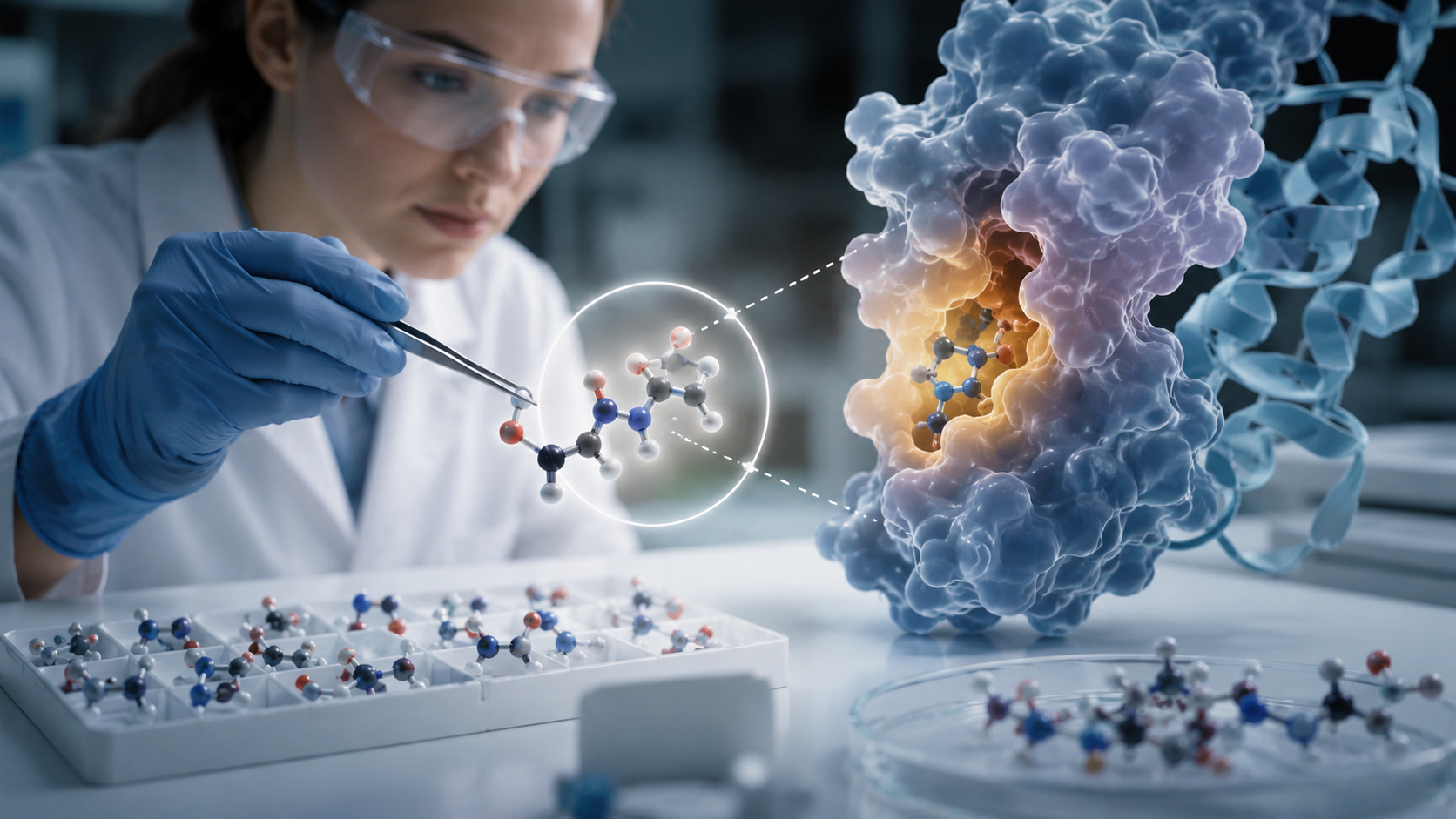
TB-500 replicates the single segment of Thymosin Beta-4 responsible for binding G-actin, at a ratio of one molecule for each unit of free actin. This is not a generic action. It is a specific, well-characterized molecular interaction, with direct consequences for the cell’s capacity to reorganize.
Why a fragment, and not the whole protein?
Thymosin Beta-4 is a 43-amino acid protein present in virtually every tissue of the human body. Researchers identified that most of its actin-binding activity is concentrated in a specific region: the sequence spanning positions 17 to 23, the heptapeptide Ac-LKKTETQ.
When that sequence was isolated and synthesized independently, it demonstrated the capacity to bind G-actin comparably to the full-length protein, in in vitro models. This created a valuable research tool: instead of working with the recombinant full-length protein, which is more complex and expensive to produce, research groups began using the synthetic fragment to study actin dynamics specifically.
TB-500 ≠ Thymosin Beta-4. TB-500 is a 7-amino acid fragment (Ac-LKKTETQ, positions 17-23) of Thymosin Beta-4, a 43-amino acid protein. They share the actin-binding domain, but they are distinct molecules. Available clinical data, including Phase I, II, and III trials, were conducted with the full-length protein (recombinant Thymosin Beta-4), not with the TB-500 fragment specifically. This distinction is critical for interpreting the scientific literature.
That specificity is one of the reasons TB-500 is particularly interesting as a research tool: it allows a specific mechanism, the regulation of the G/F-actin balance, to be isolated, without the additional interactions the complete protein may trigger. It is like studying the function of a single engine component before attempting to understand the whole engine.
What laboratories observed with TB-500
The most direct studies with the TB-500 fragment in experimental models focus on what the compound does to the actin balance and its cellular consequences. In cultures of endothelial cells and keratinocytes, the cell types most relevant to tissue-repair studies, the presence of the compound was associated with measurable changes in cell migration dynamics.
The most common method for quantifying this effect is the scratch assay: researchers grow a dense layer of cells in a plate, make a scratch through the center (simulating a “wound”), and measure how long it takes the cells at the edges to migrate and close the gap. In models using fragments of the Thymosin Beta-4 sequence that include the Ac-LKKTETQ domain, the closure rate exceeded that of controls.
What makes TB-500 relevant for research is not a vague claim that it “regenerates tissue.” It is the precision of the mechanism: a specific molecular interaction, with a specific protein, with measurable consequences in controlled cell models.
Another line of research involves the ILK-Akt pathway: studies with full-length Thymosin Beta-4 demonstrated that the protein activates integrin-linked kinase (ILK), which in turn phosphorylates Akt, a cell-survival protein. The extent to which this mechanism is replicated by the TB-500 fragment specifically remains under investigation, but the structural overlap of the functional domain justifies the interest.
SCIENTIFIC CONTEXT. The data on ILK-Akt in cardiac models (Bock-Marquette et al., Nature 2004) and on activation of epicardial progenitors (Smart et al., Nature 2007) were obtained with full-length Thymosin Beta-4, not with the TB-500 fragment. These are important contextual scientific references, but they do not constitute direct evidence about the synthetic fragment.
Why specificity is the most important story
There is a tendency in popular science journalism, and even in part of scientific communication, to treat a fragment and its parent protein as interchangeable. “It’s the same mechanism, so it’s the same thing.” But it is not.
A 43-amino acid protein has multiple functional domains, multiple possible interactions, and a pharmacokinetic behavior entirely different from a heptapeptide. The fragment may preserve actin-binding activity, and it apparently does, but it loses other interactions the complete protein performs. In some contexts that may be an advantage (greater specificity). In others, it may mean that certain effects observed with the full-length protein simply do not occur with the fragment.
It is precisely for this reason that researchers working with TB-500 are careful to distinguish what has been demonstrated with the fragment from what has been demonstrated with the parent protein. This distinction does not diminish scientific interest in the compound, on the contrary, it clearly defines what still needs to be investigated.
What this represents for research in regenerative biology
Actin biology is one of the most active areas of contemporary cell biology. The cytoskeleton, of which actin is a central component, is involved in virtually every cellular process that matters to regenerative medicine: migration, division, adhesion, response to mechanical damage, extracellular signaling.
A compound that precisely regulates the G/F-actin balance represents, for research groups in this area, an experimental tool with broad applications. Not as a treatment, but as an instrument for understanding what happens in models of wound, ischemia, inflammation, and repair. The value of a research tool is measured not by regulatory approval, but by the quality of the questions it makes it possible to ask.
And the questions TB-500 makes it possible to ask, about how cells move, about what determines whether a repair is organized or chaotic, about the relationship between actin dynamics and the quality of healing, are among the most promising in regenerative biology today.
EDITORIAL NOTE: This article is produced for editorial and scientific research purposes. TB-500 is an RUO (Research Use Only) compound, intended exclusively for laboratory investigation. No therapeutic claim is made or implied. Full-length Thymosin Beta-4 data are mentioned solely as scientific context and identified explicitly throughout the text, they do not represent direct evidence about TB-500 specifically.