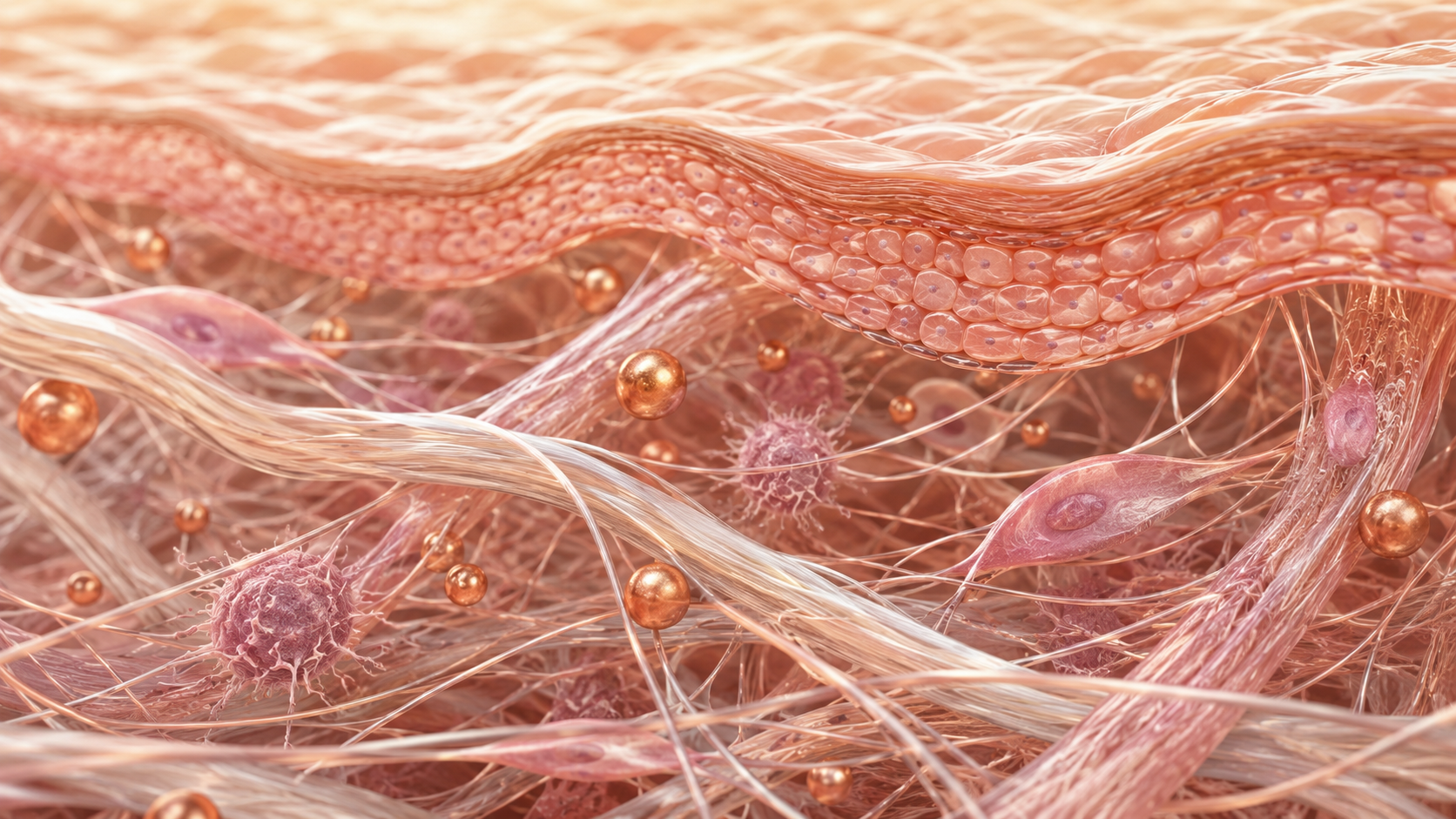
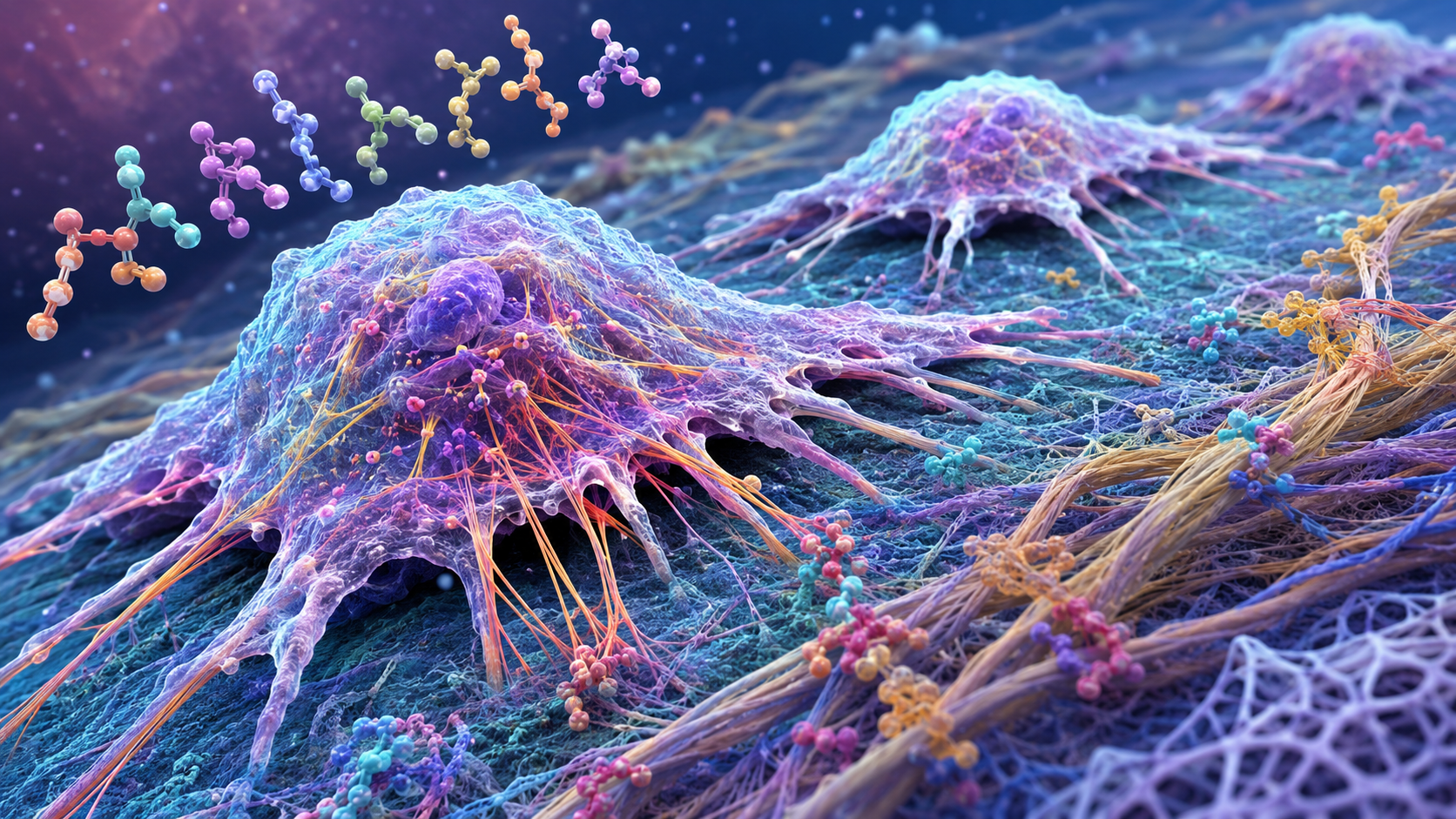
When scientists identified that most of the action of a complex protein was concentrated in a seven-amino acid piece, the logical decision was to synthesize that piece and study it in isolation. Not out of simplification, but out of precision. TB-500 is that bet: the fragment carrying the central mechanism, available as a research tool with a specificity the complete protein does not allow. What laboratories are discovering with it changes the conversation about what a fragment can be.
There is a logic that seems obvious but is rarely articulated clearly: large proteins do many things at once. A 43-amino acid protein does not have a single role, it interacts with dozens of molecular partners, activates multiple signaling pathways, and produces effects that are often difficult to attribute to a specific mechanism.
For a researcher who wants to understand how actin regulation affects cell migration in a dermal wound, working with the full-length protein is like trying to hear a single instrument in an entire orchestra. You know the instrument is there. But isolating its specific contribution is technically far more difficult.
This is where the logic of TB-500, the Ac-LKKTETQ fragment, seven amino acids, positions 17 to 23 of Thymosin Beta-4, begins to make sense as a scientific tool.
The discovery of the functional domain
In the 1990s, researchers conducting structural studies on Thymosin Beta-4 identified that the protein’s capacity to bind globular actin was located predominantly in a specific region of the sequence. That region, which became known as the actin-sequestering domain, corresponds to the heptapeptide Ac-LKKTETQ.
When that sequence was synthesized independently and tested in in vitro models, it demonstrated the capacity to bind G-actin comparably to the full-length protein in direct binding assays. This does not mean the fragment is identical to the protein in every respect, far from it. But it indicates that, for the specific mechanism of actin interaction, the fragment is functionally relevant.
Synthesizing the fragment that carries the central mechanism is not simplifying the molecule, it is isolating the variable that matters. In experimental science, this is called a control. It is how serious research works.
This discovery opened a line of research that TB-500 came to occupy specifically: studying the effects of actin modulation in contexts of injury and repair, with a tool that acts through a well-defined mechanism, without the additional interactions of the parent protein.
What TB-500 makes it possible to study that the complete protein does not
The practical difference between working with full-length Thymosin Beta-4 and with the TB-500 fragment in research contexts is significant across three dimensions:
Mechanistic specificity: when an experiment with TB-500 produces a result, it is possible to attribute that result, with greater confidence, to the modulation of actin dynamics, because that is the principal characterized mechanism of the fragment. With the complete protein, other simultaneous mechanisms complicate interpretation.
Reproducibility: short synthetic peptides like TB-500 can be produced with high purity and consistency between lots. The full-length recombinant protein is more expensive, harder to produce uniformly, and more sensitive to process variation.
Cost and accessibility: in practical terms, high-purity lyophilized TB-500 is significantly more accessible for research groups than the full-length recombinant protein. This has real implications for how many laboratories can conduct experiments, and how often.
What experimental models showed
The studies most directly relevant to TB-500 as a fragment involve in vitro models of cell migration and actin-dynamics assays. In cultures of human keratinocytes and endothelial cells (HUVEC), researchers using fragments containing the Ac-LKKTETQ sequence documented measurable changes in migration rate in in vitro wound-closure assays.
The mechanisms observed are consistent with what would be expected from actin biology: more G-actin available for directional polymerization, more efficient lamellipodia formation at the leading edge of cell migration, and greater cell displacement speed toward the empty space of the scratch assay.
| Experimental model | Scratch assay in keratinocyte and endothelial (HUVEC) monolayers |
| Mechanism investigated | Regulation of the G/F-actin balance via G-actin sequestration by the Ac-LKKTETQ domain |
| Parameter measured | In vitro “wound” closure rate over 12-24 hours |
| Observed result | Increased cell migration speed compared with untreated controls |
| Critical limitation | In vitro data, there are no published clinical trials with the TB-500 fragment in humans |
What these data do not do, and this is fundamental, is establish that TB-500 accelerates healing in humans. In vitro models of cell migration are starting points of scientific investigation, not endpoints. The distance between “cells migrated faster in a plate” and “human tissue healed better in a controlled clinical trial” is enormous, and crossing it requires a research path that, for the TB-500 fragment specifically, is still underway.
SCIENTIFIC CONTEXT, FULL-LENGTH THYMOSIN BETA-4. The most advanced clinical data in humans involving Thymosin Beta-4, including RegeneRx’s Phase III trial for neurotrophic keratitis (RGN-259, which used the full-length protein) and the Phase I IV-safety studies, were conducted with the complete recombinant protein, not with the TB-500 fragment. These data provide valuable scientific context about the biology of the parent molecule, but they do not constitute direct clinical evidence about the synthetic fragment.
The question research is trying to answer
The central question motivating scientific interest in TB-500 as a research tool can be framed this way: to what extent is precise, specific modulation of the actin balance, by a high-purity synthetic fragment, sufficient to produce the tissue-repair effects observed with the parent protein in animal models?
It is a legitimate question, of high scientific value, and still without a definitive answer. But it is exactly the kind of question that defines the frontiers of an expanding research area.
The most interesting question in TB-500 research is not “does it work?”, it is “how much of the parent protein’s mechanism is present in the fragment, and in what contexts is that sufficient to produce relevant effects?” That precision is what separates science from speculation.
Groups working with actin biology and tissue repair have particular interest in this question because it touches a broader principle of molecular biology: how much of a protein’s function is really concentrated in its identified functional domains? TB-500 is, in this sense, an experiment in progress, a scientific bet that, if validated in increasingly complex models, could have implications beyond the specific molecule.
Why fragments matter for the future of medicine
The logic of the functional fragment is not exclusive to TB-500. It is an approach that increasingly permeates the development of therapeutic peptides: identify the functional domain of a protein, synthesize it, and study it with the precision the complete protein does not allow.
This approach has advantages beyond basic research: smaller peptides generally have greater chemical stability, greater predictability of behavior, and lower production complexity than full-length recombinant proteins. If the relevant pharmacological effects are confirmed in translational models, development feasibility is greater.
For TB-500, that path is still being paved. The data that exist on the specific fragment, mainly in in vitro models and in animal models with structurally related compounds, are sufficient to justify scientific interest, but insufficient for clinical claims of any kind.
What they are sufficient to say is this: TB-500 is a well-characterized fragment, with an identified mechanism of action, with a scientific basis for its use as a research tool, and with a central open question that science has not yet fully answered. In biology, that is the beginning of something.
EDITORIAL NOTE: This article is produced for editorial and scientific research purposes. TB-500 is an RUO (Research Use Only) compound, intended exclusively for laboratory investigation. No therapeutic claim is made or implied. Where full-length Thymosin Beta-4 data are mentioned, this is indicated explicitly, those data do not represent direct evidence about the TB-500 fragment.