It was 1973. Loren Pickart, a researcher at the University of California, San Francisco, was studying why old tissues lose the capacity to function like young tissues. The question was old. The answer he found was not.
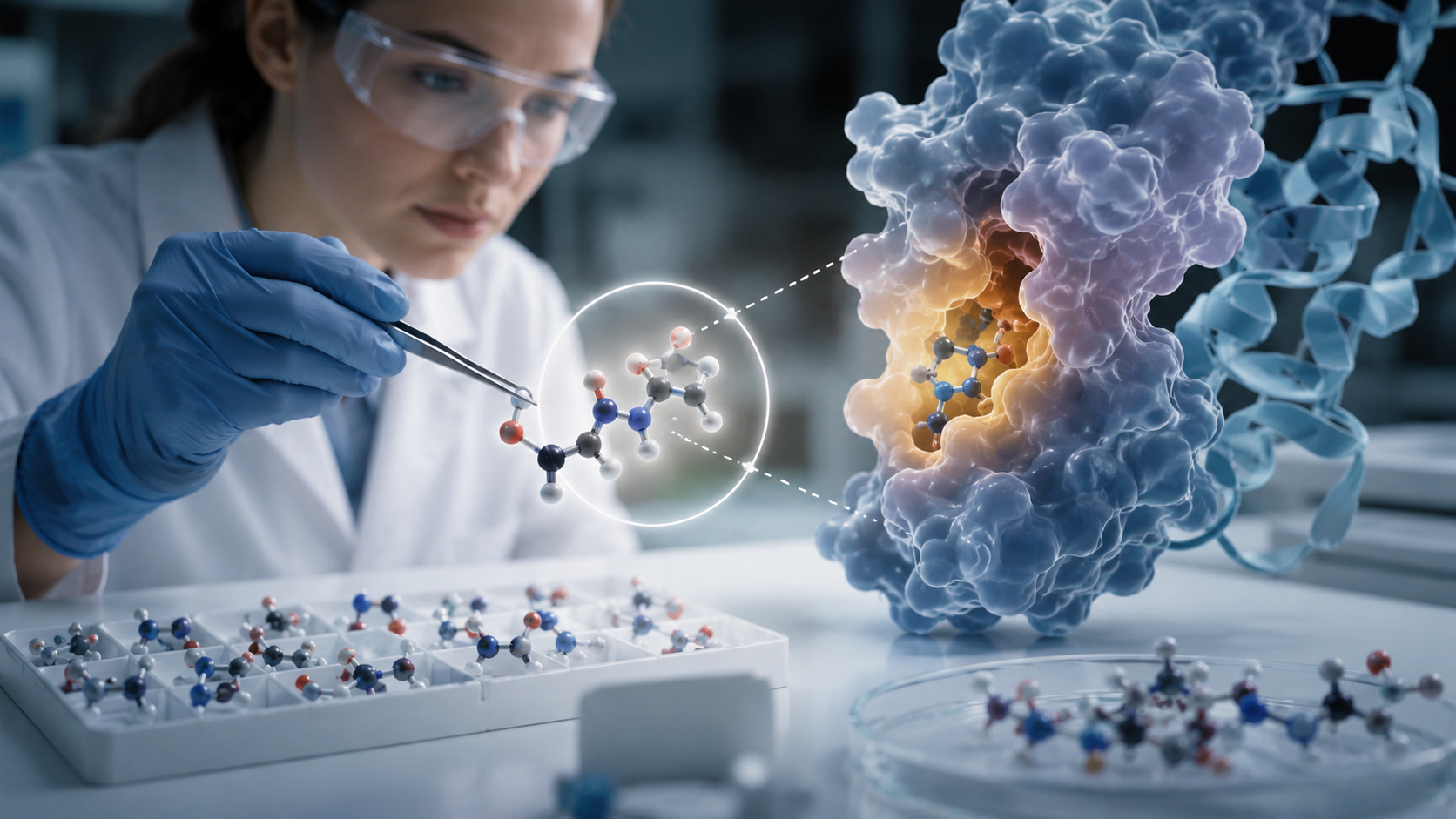
In his laboratory, Pickart isolated from human blood plasma a tiny molecule, a tripeptide, that is, a chain of just three amino acids, that had an extraordinary property: it was able to induce aged hepatic tissue to synthesize proteins as if it were young again. The precise mechanism he did not yet know. But the observation was real. And the molecule had a name: GHK-Cu.
The “Cu” in the name is not accidental. It is the chemical symbol for copper, an element the molecule carries with it as part of its structure. GHK are the initials of the three amino acids that compose it: glycine, histidine, lysine. Three pieces. One complex. And a research story spanning more than fifty years.
The biological clock no one told you about
Here is the fact that makes GHK-Cu different from most compounds studied in the biology of aging: it exists naturally in your body. It is not a synthetic molecule created in a laboratory to mimic something nature does. It is the very molecule nature makes, and that science has learned to produce with enough purity to study in detail.
Studies indicate that, around the age of 20 to 25, plasma levels of GHK-Cu in human blood are around 200 nanograms per milliliter. It is a small number in absolute terms, but biologically relevant. The problem begins to appear decades later.
By age 60, the plasma concentration of GHK-Cu drops to approximately 80 ng/mL. A reduction of 60% relative to the youthful peak, which coincides, point for point, with the known reduction in the regenerative capacity of the adult organism.
Coincidence? Researchers in the field do not think so. The scientific literature is actively investigating whether this decline is part of the mechanism by which tissue aging sets in, that is, whether the fall in GHK-Cu is not merely a marker of aging, but one of its actors.
It is important to stress: correlation is not causation. Science does not, for now, claim that replacing GHK-Cu reverses aging. What it investigates, with growing sophistication, is the role this decline plays in the set of changes that make a 60-year-old tissue different from a 25-year-old one.
The matrikine: the signal that emerges from the wound
There is a concept in molecular biology called a matrikine. These are peptide fragments that arise when the extracellular matrix, the protein structure that surrounds and supports cells, is damaged. Think of them as emergency messengers: when tissue breaks, specific fragments are released and function as repair signals to neighboring cells.
GHK is a matrikine. More specifically: the amino acid sequence that composes it is present in the α2(I) chain of type I collagen, the most abundant protein in the human body. When collagen is degraded by proteases at the site of an injury, GHK is released. It is the tissue telling itself: “repair is needed here.”
This discovery changed the way researchers understand GHK-Cu. It is not an external agent the organism merely tolerates, it is a molecule the tissue itself generates as part of its damage-response protocol. What science now investigates is whether, with the decline of its levels with age, this protocol loses part of its efficiency.
If GHK-Cu is the signal the tissue emits when it is damaged and needs to repair itself, what happens when that signal grows weaker with aging? That is the hypothesis organizing much of contemporary research on the molecule.
These are still hypotheses. Models. Preclinical studies and computational analyses. The biology of aging is complex enough to humble any definitive claim. But the direction of research is clear, and intriguing enough to justify decades of scientific attention.
What comes next, and why it matters
The most ambitious hypothesis beginning to circulate in regenerative-medicine laboratories is straightforward: if GHK-Cu is an endogenous repair signal, and if its levels decline consistently with age, then a logical line of research would be to investigate what happens when those levels are modulated in experimental models, and whether tissue-regeneration patterns respond to that modulation.
This is not a baseless hypothesis. Preclinical models already demonstrate that GHK-Cu, under experimental conditions, stimulates fibroblasts to produce more collagen, elastin, and glycosaminoglycans, the principal structural proteins of the extracellular matrix. In animal models, studies indicate accelerated healing, granular tissue formation, and angiogenesis. The data are robust in the preclinical context. The transition to humans, careful as it must be, is the natural frontier of the investigation.
If the mechanisms observed in animal models and in vitro are confirmed in controlled clinical studies with humans, GHK-Cu could become one of the reference compounds in research on the modulation of tissue aging, not as a medicine, but as a tool of biological investigation with therapeutic potential to be rigorously tested.
The question science asks now is not “does GHK-Cu work?” It is “in what contexts, at what dosages, and with what protocols can its mechanisms be reproducible in humans?”, and that is a far more interesting question.