The Level That Falls with Age, and What Science Is Investigating
A protein produced in the mitochondria declines consistently across the human lifespan. Researchers are investigating whether this progressive silence is a cause, a consequence, or both, of metabolic aging.
Imagine there is a chemical signal in your blood that is higher when you are young and decreases, measurably and consistently, as you age. It is not a hypothesis. For the peptide MOTS-c, this pattern was documented in an observational study of 75 human individuals divided into three age groups: young (18-30 years), middle-aged (45-55 years), and older (70-81 years). Plasma levels of endogenous MOTS-c fell progressively across the groups.
It is a finding that seems simple. But it carries implications that are moving one of the most active fields of aging biology.
Why would a mitochondrion send signals to the blood?
This is perhaps the most fascinating question surrounding MOTS-c. Mitochondria were long seen as cellular power plants, organelles responsible for producing ATP, the universal fuel of the cell. That view is not wrong, but it was incomplete.
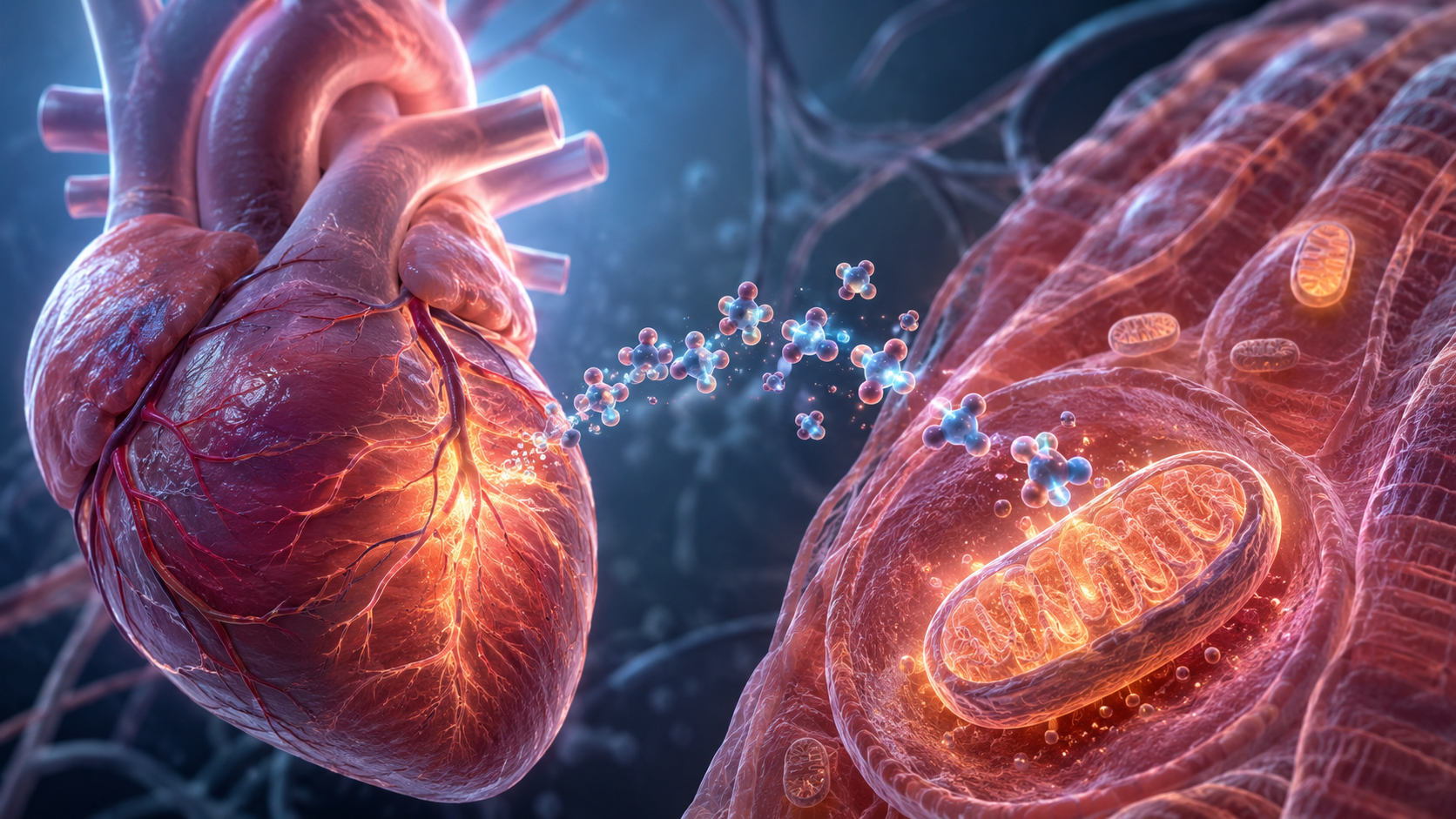
In the past decade, it became clear that mitochondria also communicate. They produce signaling molecules, named mitokines, that are not confined to the cell of origin. Some enter the bloodstream and act on distant tissues. MOTS-c is one of those mitokines: produced in muscle during exercise, it can be detected in plasma. It is endocrine signaling that departs from the mitochondria.
When the levels of this signaling fall with age, the question that naturally emerges is: what is lost along with it?
“Plasma MOTS-c levels were progressively reduced with aging in individuals across three age groups.”, observational data, n=75
What preclinical research indicates
In the foundational study by Lee et al. published in 2015 in Cell Metabolism, the most prestigious journal in cellular metabolism, USC researchers demonstrated that the administration of MOTS-c in mice prevented insulin resistance induced by a high-fat diet and by aging. The mechanism: MOTS-c activates AMPK, a kind of central sensor of cellular energy, which in turn coordinates a broad metabolic program, glucose uptake, fatty acid oxidation, mitochondrial biogenesis.
More recently, Reynolds et al. (Nature Communications, 2021) showed that mice treated with MOTS-c late in life displayed greater physical capacity and better muscle homeostasis than untreated controls. The paper’s language is careful, the authors speak of “healthspan,” not rejuvenation, but the direction of the investigation is clear.
These are data in animal models. Extrapolation to humans is not automatic, and the authors are emphatic about this. But the observational decline profile in humans, combined with the interventional data in mice, builds a scientific narrative that would be hard to ignore.
The signaling-deficit hypothesis
There is a line of reasoning beginning to take shape in the literature: part of what we call “metabolic aging” may be associated with the progressive silence of signals that healthy mitochondria emit. The insulin resistance that worsens with age. The physical capacity that declines. The low-grade chronic inflammation that sets in.
MOTS-c is not the cause of any of these phenomena in isolation, the biology of aging is immensely more complex. But it may be one of the threads connecting mitochondrial function to systemic aging. A biological marker of a process we do not yet fully understand, and potentially, if the hypothesis is confirmed in human studies, a first-line research object.
Research on MDPs like MOTS-c represents one of the most promising frontiers of contemporary geroscience, the idea that mitochondria age before the rest, and that this aging has consequences that propagate to the entire organism.
Where the research stands now
The field is in a phase scientists call “translational transition”, when robust preclinical data begin to be tested systematically in human contexts. For native MOTS-c, no interventional clinical trial had been completed as of April 2026. A structurally modified analog called CB4211 completed a Phase 1a/1b focused on safety in patients with NAFLD, but the data from that analog are not transferable to the native peptide.
What exists, and is sufficient to anchor an intense research agenda, is a body of mechanistic, preclinical, and observational evidence that places MOTS-c among the most investigated compounds in mitochondrial biology applied to aging.