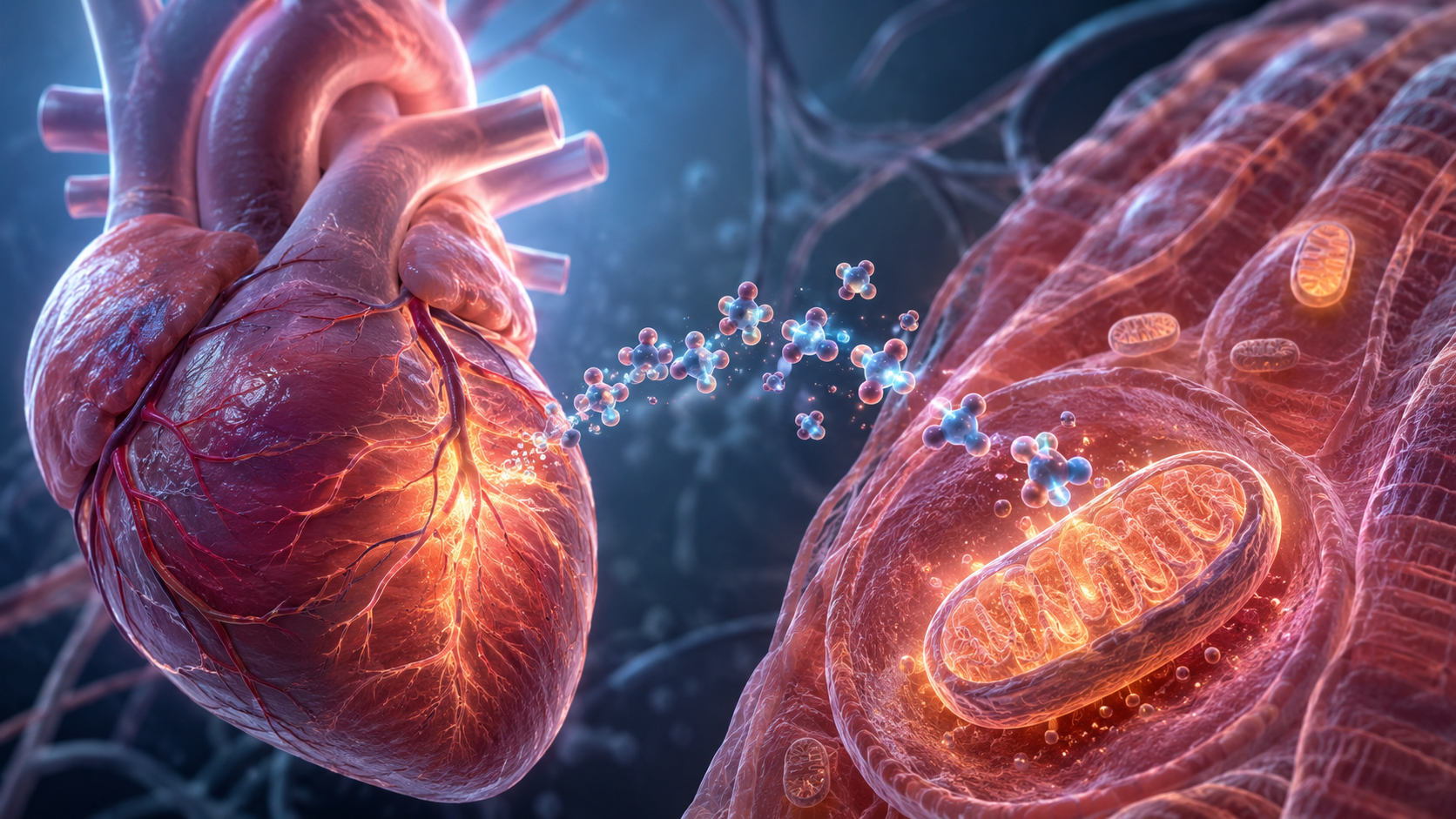
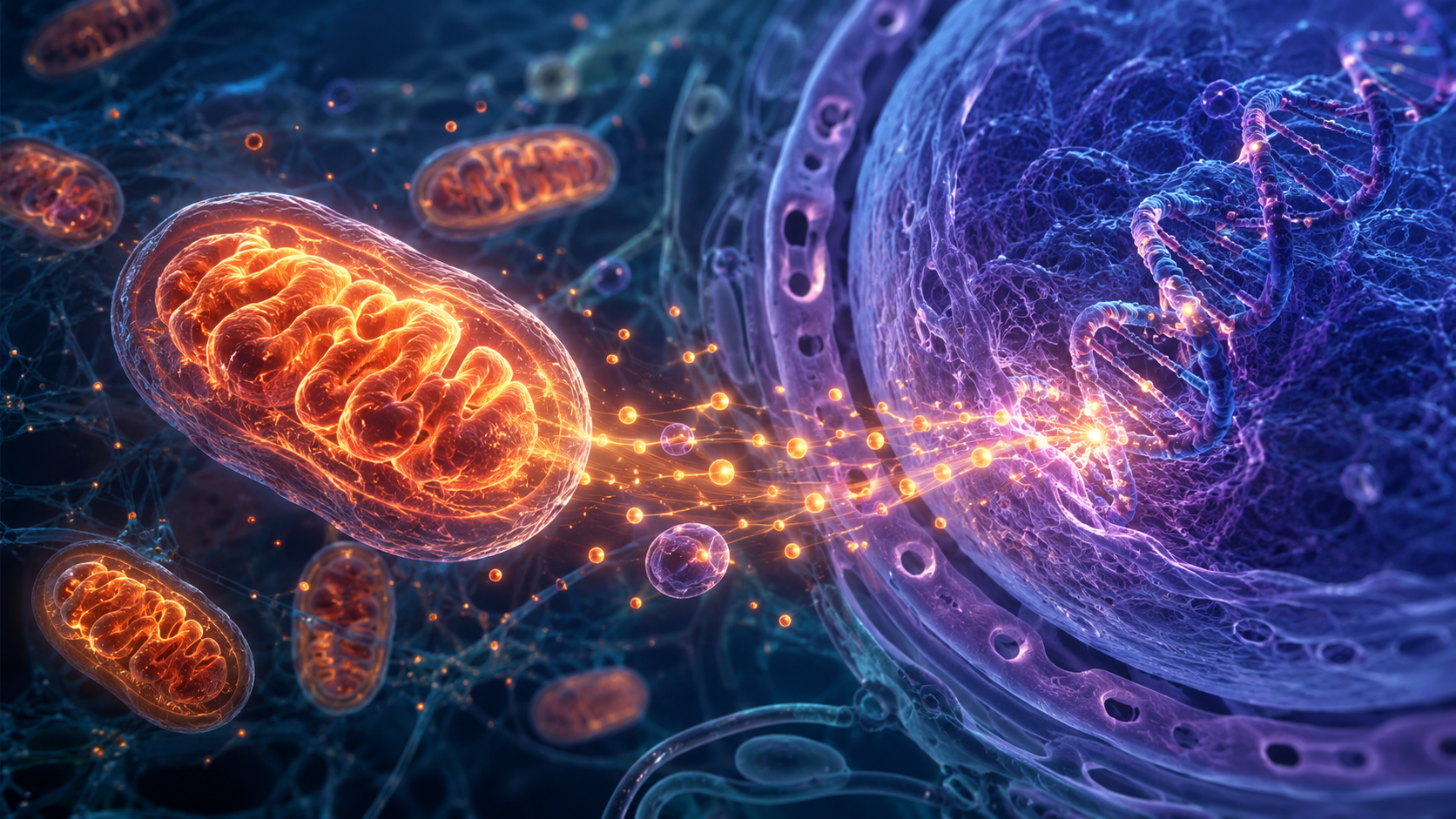
Inside every cell of your body there is a molecule that governs energy, repairs DNA, and tells your cells how much time they have. Research on NAD+ may be pointing to one of the most fundamental questions in human biology.
Biological System: Mitochondrial Energy System | Compound: NAD+ (Nicotinamide Adenine Dinucleotide) | Class: Endogenous dinucleotide coenzyme | Status: RUO, Research Use Only
Imagine you have a generator inside every cell. It produces nearly all the energy that keeps you functioning, heartbeats, thoughts, movements. That generator needs fuel to operate. NAD+ is that fuel.
It is no exaggeration to call NAD+ the central molecule of cellular life. Present in all living organisms, from bacteria to humans, Nicotinamide Adenine Dinucleotide is the coenzyme that makes possible the conversion of nutrients into energy inside the mitochondria. Without it, the respiratory chain that generates ATP, the “currency” of the cell, simply stops.
But what science began to discover with greater intensity from 2013 onward is something beyond bioenergetics: NAD+ levels fall with aging. And that decline is not trivial.
“NAD+ levels can be 10 to 80% lower in tissues of elderly individuals compared with young adults, a decline documented in studies that include human tissue.
What the decline really means
To understand why this decline matters, one must understand what NAD+ does beyond carrying electrons. The molecule is also the substrate, the “consumed ingredient”, of two of the most studied enzyme families in aging biology: the sirtuins and the PARPs.
The sirtuins (SIRT1 to SIRT7) are enzymes that regulate gene expression, DNA repair, metabolism, and inflammation. They need NAD+ to function, and when NAD+ falls, sirtuin activity falls along with it. It is a direct dependency: less available NAD+, less capacity for cellular regulation.
The PARPs, in turn, are the emergency DNA-repair enzymes. When the genome suffers damage, they are activated and consume NAD+ to carry out repair. The problem is that, with the accumulation of DNA damage that occurs naturally with aging, the PARPs become increasingly active, and more voracious in their consumption of NAD+.
The result is a cycle that research is only beginning to map in its entirety: less NAD+ → less active sirtuins → less mitochondrial biogenesis → more cellular dysfunction → more DNA damage → more PARP activation → still less NAD+.
“The question researchers are investigating is not whether NAD+ declines with aging, that is documented. The question is whether that decline is a cause or a consequence of what we call aging.
The molecule that connects twelve processes of aging
In 2013, López-Otín and colleagues published in Cell a map of the “hallmarks of aging”, biological processes that characterize cellular aging and contribute to age-related diseases. Since then, researchers have identified that NAD+ interferes with at least half of them: mitochondrial dysfunction, genomic instability, cellular senescence, metabolic dysregulation, and chronic inflammation are all mechanistically connected to NAD+ availability.
A review published in Aging and Disease in 2024 by Rahman and colleagues, from Shanghai Jiao Tong University and Tongji University, synthesized this connection in a particularly direct way: NAD+ decline is associated with twelve of the hallmarks of aging. NMN, a NAD+ precursor, restored levels in preclinical models. Emerging clinical evidence points in the same direction.
It is not that NAD+ “cures” aging. It is that the molecule appears to sit at the center of multiple processes that compose what we biologically call aging. This makes it, in the language of research, a convergence node, a point where multiple systems meet.
“If the mechanisms observed in animal models are confirmed in human populations with the same consistency, NAD+ may become one of the most studied compounds in longevity biology.
What clinical research says, and what is still missing
The clinical trials published to date work predominantly with NAD+ precursors, NR (nicotinamide riboside) and NMN (nicotinamide mononucleotide), administered orally. The biochemical engagement is well documented: these compounds raise circulating NAD+ levels consistently in middle-aged and elderly adults.
What is still under investigation is the translation of that biochemical increase into clinically measurable functional outcomes. A systematic review published in 2026, analyzing 113 studies (33 human-intervention, 28 of them randomized), found consistent metabolic, mitochondrial, and inflammatory improvements in murine models, but heterogeneity in functional outcomes in humans.
This does not mean research has reached a dead end. It means it is at the point where the most interesting science happens: when the mechanisms are mapped, the animal models show consistent results, and the clinical trials are still being designed with the precision needed to answer more specific questions, doses, populations, routes of administration, relevant primary endpoints.
The frontier of NAD+ research is not in the results we already have. It is in the questions they opened.
Connection within the AXION portfolio. NAD+ is part of the Mitochondrial Energy System, the same system as MOTS-c, SS-31 (Elamipretide), Epithalon, and SLU-PP-332. Each molecule in this system investigates a different aspect of mitochondrial function. NAD+ is the central node connecting them all: MOTS-c converges on the AMPK/NAMPT/NAD+ axis; SS-31 protects the membranes where NAD+ operates; Epithalon connects via SIRT6 and telomere maintenance; SLU-PP-332 activates the same PGC-1α pathway downstream of SIRT1.
Why this compound is in the AXION portfolio
NAD+ occupies a singular position in the Axion portfolio for a simple reason: it is not an exogenous molecule created in a laboratory to mimic something the body does. It is the endogenous compound itself, present in all cells, an inseparable part of hundreds of metabolic reactions, that research is investigating from a new angle.
The question is not whether NAD+ does something. It clearly does, the biochemistry has been mapped for decades. The question current research is pursuing is what happens when levels are maintained, restored, or modulated in aging models. And that question, by the available data, is far from being answered definitively.
What makes NAD+ a research compound of high relevance is not a consolidated clinical result. It is the position it occupies in the architecture of mitochondrial biology: central, connected, and, by the data, increasingly relevant as research on cellular longevity advances.