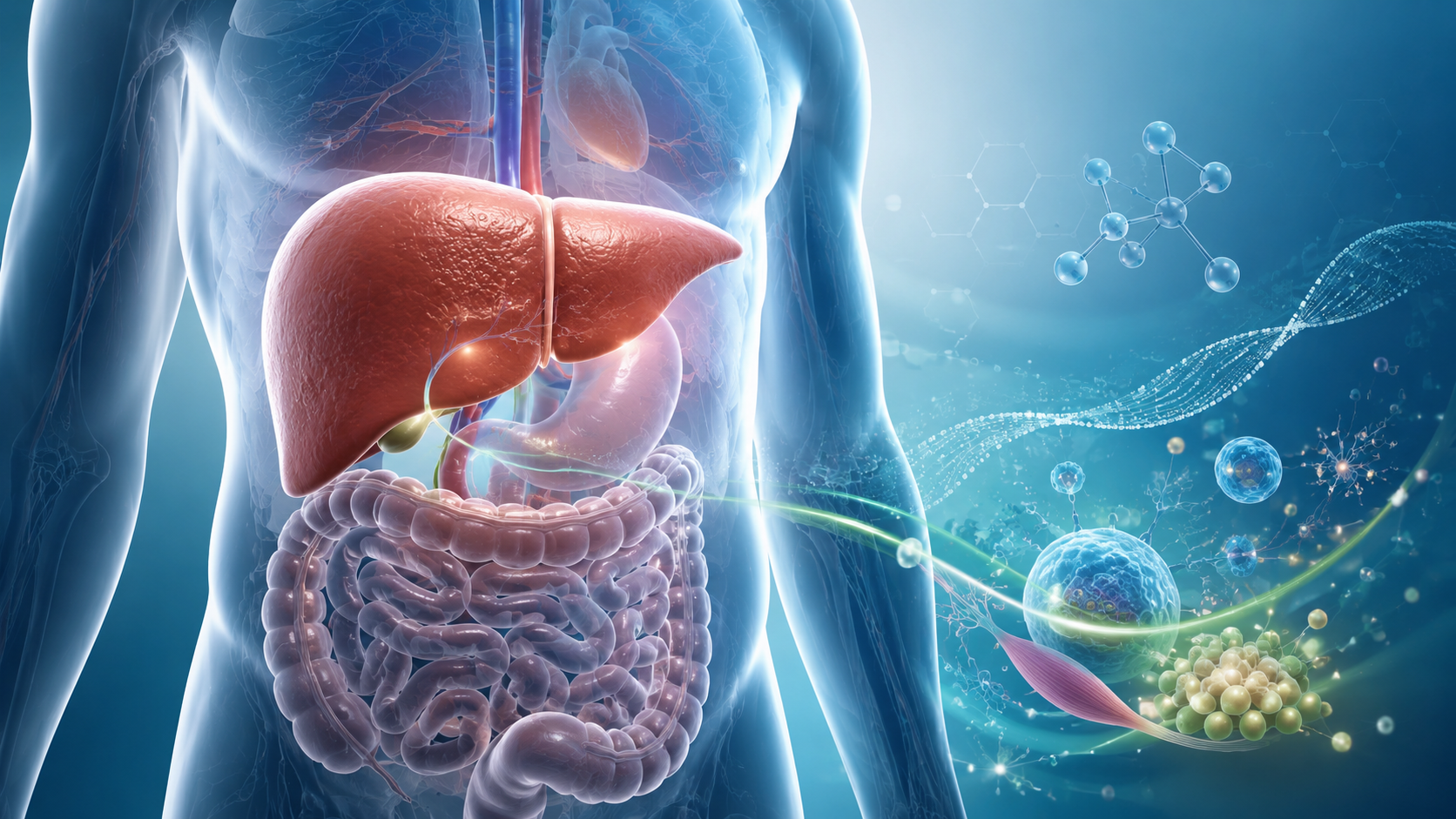
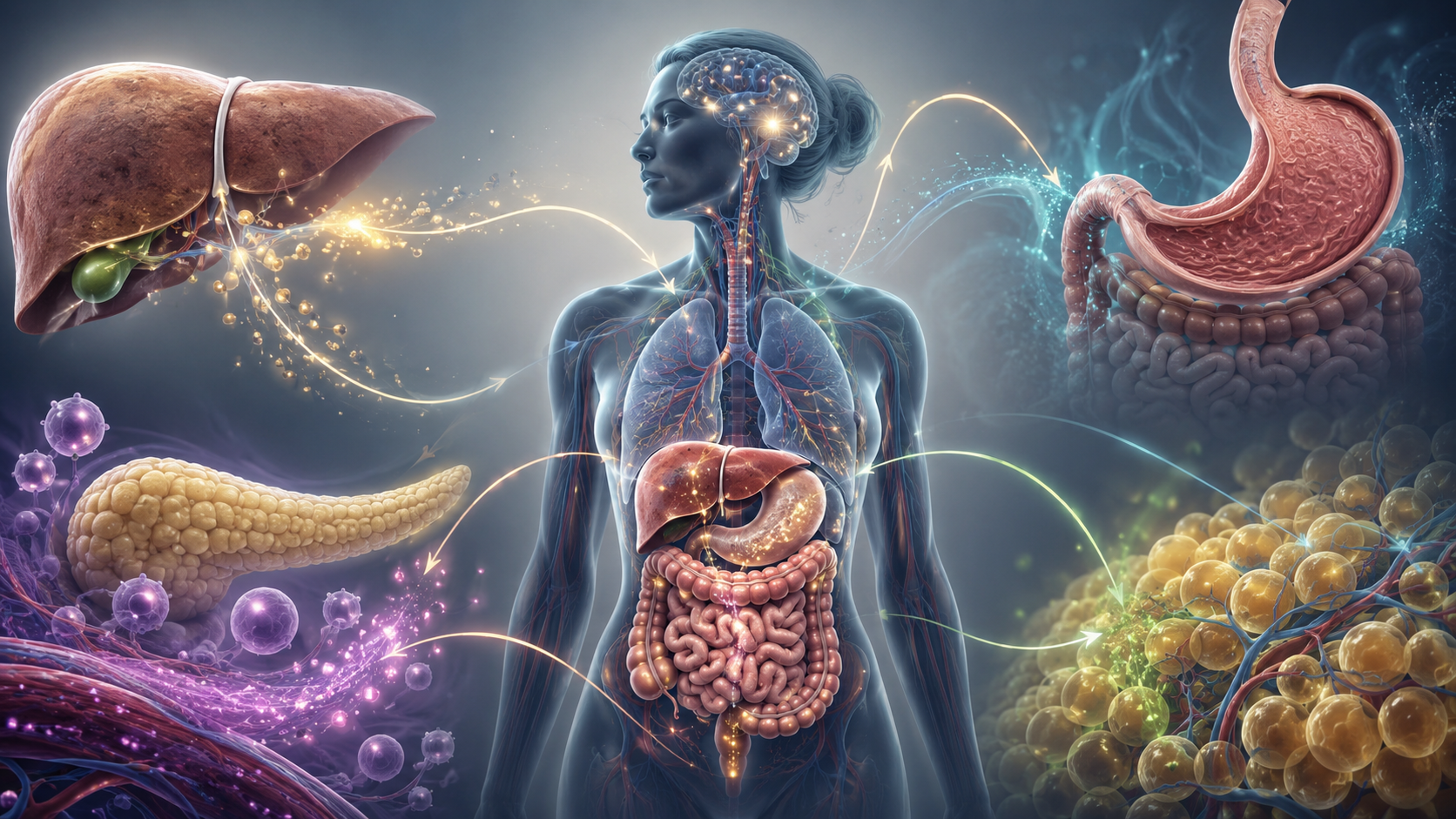
In 2021, semaglutide arrived with data that most metabolic-pharmacology researchers did not expect to see so soon. In 2022, tirzepatide surpassed it in a way that seemed improbable. In 2023 and 2025, retatrutide surpassed tirzepatide.
Understanding the pace of the revolution
The history of incretin-receptor agonists is, in certain respects, the history of an idea expanding gradually to its limits. And then discovering there was no limit where one was expected.
It all began with a relatively simple observation: the gut releases hormones after a meal that regulate the insulin response far more sophisticatedly than the pancreas can do alone. GLP-1, Glucagon-Like Peptide 1, is the most studied of these incretin hormones. When researchers began developing synthetic analogs resistant to enzymatic degradation, the hypothesis was modest: an aid in glycemic control for patients with type 2 diabetes.
What they discovered was far broader. The activation of GLP-1R not only regulated insulin, it modulated appetite via hypothalamic circuits, slowed gastric emptying, and consequently produced weight reduction as a secondary effect. That “secondary effect” would eventually become the main story.
The generational progression, in numbers
| Year | Molecule | Mechanism | Phase 3 result (weight) |
|---|---|---|---|
| 2021 | Semaglutide (Wegovy) | GLP-1R mono-agonist, 1 receptor | ~14-15% body-weight reduction over 68 weeks (STEP-1) |
| 2022 | Tirzepatide (Zepbound) | GLP-1R + GIPR dual agonist, 2 receptors | ~20-22% body-weight reduction over 72 weeks (SURMOUNT-1) |
| 2025 | Retatrutide (LY3437943) | GLP-1R + GIPR + GCGR triple agonist, 3 receptors | ~28.7% body-weight reduction over 68 weeks (TRIUMPH-4)* |
* Preliminary data from Eli Lilly press release (December 2025). Peer-reviewed publication pending.
Each generation added a receptor. Each addition produced a leap that earlier models did not fully predict. The pattern suggests metabolic biology has more layers than classical pharmacology assumed.
What changes when you add glucagon
The difference between the dual agonism of tirzepatide and the triple agonism of retatrutide lies, in large measure, in glucagon. And glucagon is, perhaps, the most counterintuitive ingredient of this story.
For decades, glucagon was studied mainly as the antagonist of insulin, the hormone that raises glucose when it falls, the signal diabetics need to suppress. The idea of developing a compound that activates the glucagon receptor in the context of a metabolic therapy sounded, to many researchers, paradoxical. If glucagon raises glucose, why activate it?
The answer the studies built is more sophisticated. Glucagon activates the GCGR receptor in the liver, and in that context it not only regulates hepatic glucose production: it also increases energy expenditure, stimulates fatty-acid oxidation, and potentially mobilizes lipid deposits that other mechanisms do not reach with the same efficiency. In a compound where the GLP-1R and GIPR components already control the insulin response and glycemic homeostasis, the glucagon component can act without the hyperglycemic effect that would make its isolated use problematic.
It is a kind of molecular division of labor: GLP-1 and GIP manage the sugar; glucagon releases the stored energy. Retatrutide was engineered to orchestrate all three at once.
GLP-1 and GIP manage the sugar. Glucagon releases the stored energy. Retatrutide was built to orchestrate the three, at the same time.
Why this generation is structurally different
It is not only the number of receptors that differentiates retatrutide. It is the molecular engineering that made a triple compound viable without losing weekly administration, a central practical requirement for any chronic therapy.
The principal technical barrier of therapeutic peptides is their rapid degradation in the organism. Native GLP-1 has a half-life of minutes. Semaglutide solved this with an 18-carbon lipid chain bound to albumin. Tirzepatide used a different approach. Retatrutide was built with three simultaneous modifications: substitutions of non-natural amino acids (Aib at positions 2 and 20, and alpha-methyl-leucine at position 13) that resist the DPP-4 enzyme, combined with a 20-carbon lipid chain that binds to plasma albumin. The result is a half-life of approximately six days, compatible with weekly administration in clinical studies.
Each modification solved a different problem. Aib2 protects from enzymatic cleavage. The C20 chain extends the half-life. Aib20 and alpha-methyl-leucine optimize the activity profile on GIPR and the overall structural conformation. What looks like a simple peptide is, in practice, an engineering solution to a complex pharmacological problem.
The question that defines the next era
If mono-agonism produced 15%, dual produced 20%, and triple produced 28%, the question researchers are beginning to formulate is: what is the effect of a quadruple agonism? Are there other hormone receptors that, when recruited in a coordinated way, could push the effect beyond what we have seen?
This is not irresponsible speculation, it is the natural direction of research when a pattern establishes itself. The biology of appetite and energy metabolism involves dozens of hormonal signals: amylin, PYY, CCK, FGF21, among others. Some of these are already being studied as additional targets. The question is not whether there will be a fourth generation, but when and with what mechanistic profile it will organize itself.
Retatrutide, in this sense, is less a destination than an inflection point. A compound that demonstrated that triagonism of incretin receptors is pharmacologically viable and clinically relevant, and that, with that, opened the map for what comes next.
Retatrutide is not the destination, it is the inflection point. The compound that demonstrated three receptors can be orchestrated simultaneously and that reframed what the next generation will allow itself to investigate.
What science still needs to answer
The generational progression is impressive. But a responsible science journalist ends with the open questions, not with the triumph narrative. Retatrutide has no regulatory approval in any jurisdiction (April 2026). The most robust Phase 3 data publicly available are preliminary, press releases, not complete peer-reviewed publications. The pivotal obesity studies of the TRIUMPH Program have not yet reported results.
The long-term cardiovascular safety profile is being evaluated in TRIUMPH-3, still underway. What happens to weight after discontinuation is an open question, and a relevant one, given that the reasonable expectation, as with the whole class, is significant relapse. The exact mechanism by which retatrutide reduces LDL by ~20% is still hypothesis, not established fact.
Science continues. The data arrive. The conversation about what is possible in metabolic biology has never been so open. And retatrutide, with all its question marks still active, is at the center of that conversation in 2026.