For decades, researchers working in metabolic pharmacology operated with an implicit ceiling: getting a medication to produce a sustained reduction of 15% of body weight would already be extraordinary. When semaglutide arrived with consistent results of 10 to 15% in clinical trials, the scientific community reacted with contained but genuine enthusiasm. When tirzepatide surpassed that mark, reaching 20% in some patient profiles, the conversation changed tone.
Then came the retatrutide results.
The TRIUMPH-4 study, conducted by Eli Lilly with 751 participants and 68 weeks of follow-up, recorded an average reduction of 28.7% of body weight at the 12 mg dose, equivalent to approximately 71 pounds (32 kilograms) in absolute terms. It is the highest figure ever documented in a randomized controlled Phase 3 trial for obesity. A milestone that, for many researchers, redefined what is considered the ceiling of the possible.
28.7% average reduction in body weight over 68 weeks. The highest number ever recorded in a Phase 3 trial for obesity. No medication had reached this.
What is different about this molecule’s architecture
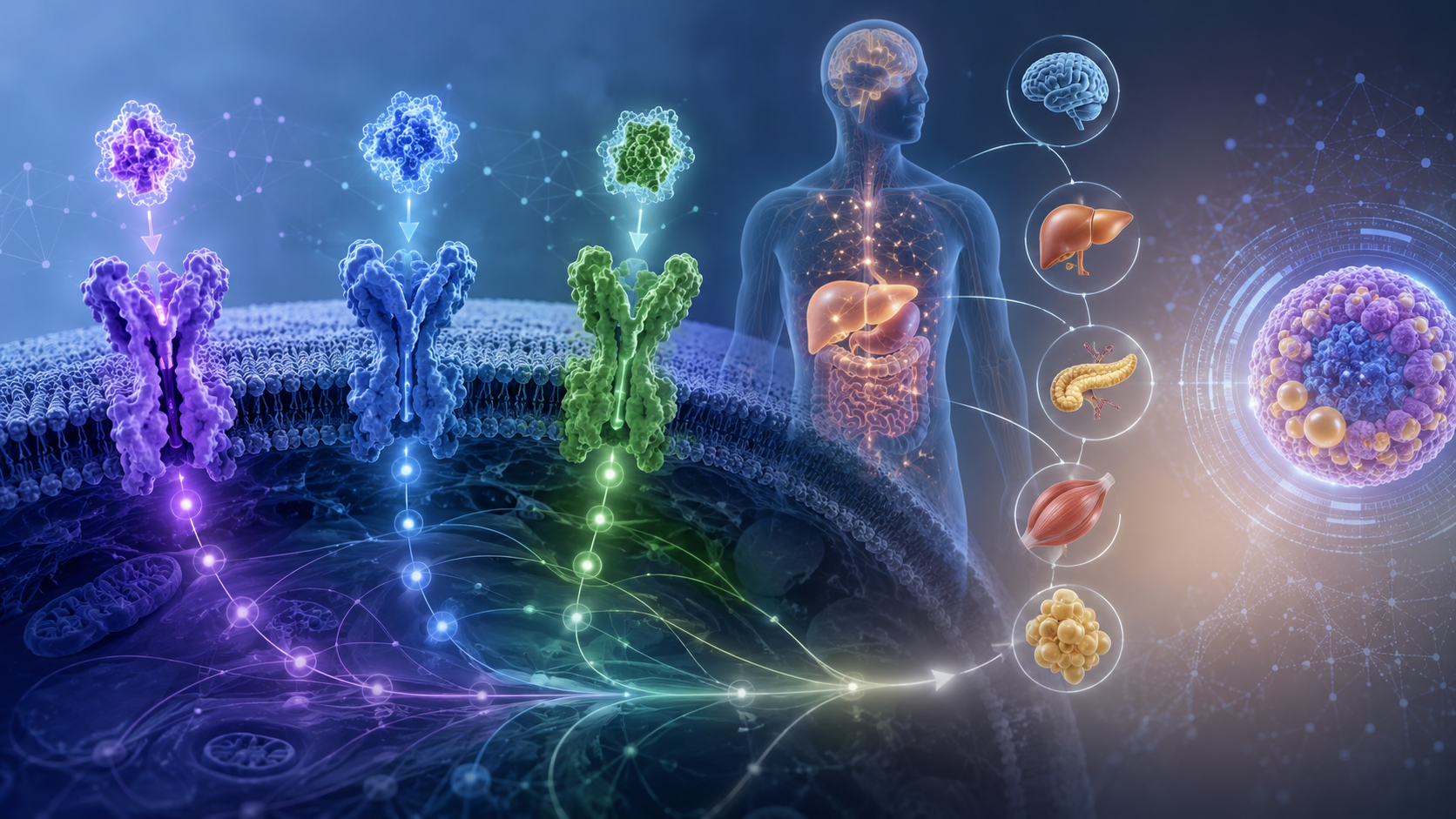
Retatrutide did not reach this result by accident. It was deliberately engineered to do something earlier molecules could not: activate three hormone receptors at the same time. GLP-1, GIP, and glucagon, three distinct metabolic signals that normally operate in different contexts, acting in coordination on the same system.
GLP-1 was already familiar. It is the mechanism behind Ozempic and Wegovy, moderating appetite, slowing gastric emptying, regulating postprandial insulin secretion. GIP was the addition of tirzepatide, a hormone that potentiates the insulin response in a glucose-dependent manner and interferes with lipid metabolism. Retatrutide took those two pathways and added a third: glucagon.
Glucagon is the hormone that, for centuries, was seen almost exclusively as the villain of the metabolic story, the signal that raises blood glucose. But when activated in a controlled way, in a research context, studies suggest it also increases energy expenditure, accelerates fat oxidation in the liver, and potentiates lipolysis. That is exactly what retatrutide was built to explore.
Glucagon was the villain of the metabolic story. Retatrutide recruits it as an ally, and the data suggest that makes all the difference.
The generational progression that led here
To understand the magnitude of what TRIUMPH-4 documented, it helps to walk through the timeline. In 2021, semaglutide reached the Phase 3 obesity trials with results that reached 14-15% of weight reduction, impressive for a GLP-1R mono-agonist. In 2022, tirzepatide pushed that number to 20-22% with dual GLP-1/GIP agonism. In 2023, the Phase 2 trials of retatrutide showed 24.2% over 48 weeks. In 2025, TRIUMPH-4 recorded 28.7% over 68 weeks.
It is a progression that, plotted on a graph, looks almost linear, except that each step required a different molecular innovation, a new target, a new hypothesis about how human metabolism works. The science here is not incremental. It is structural.
Researchers working in metabolic biology are attentive to a central question: if each new generation of incretin-receptor agonists surpassed the previous one so consistently, where is the real ceiling? TRIUMPH-4 did not answer that question. But it dramatically shifted the perception of where it should be asked.
What the data do not yet say
It would be irresponsible to end without the counterpoint. The TRIUMPH-4 data were released in December 2025 through a corporate press release from Eli Lilly. The full publication, peer-reviewed, had not yet occurred as of April 2026. This does not invalidate the numbers, large Phase 3 trials have rigorous verification processes, but it places an important asterisk: data not published in peer review are preliminary data, however impressive they may seem.
There are also questions the available studies do not answer. What happens to weight after discontinuation of the compound? The long-term cardiovascular safety data are still being collected, TRIUMPH-3, the cardiovascular-outcomes trial, is underway. Maintenance of the result beyond 68 weeks is a frontier still under investigation.
Retatrutide does not have regulatory approval from the FDA, ANVISA, or any agency as of April 2026. It is, in the vocabulary of clinical research, in Phase 3, which is the penultimate step before regulatory submission. The NDA submission to the FDA is projected for late 2026 or early 2027.
TRIUMPH-4 did not answer where the ceiling is. But it dramatically shifted the perception of where that question should be asked.
Why this moment matters for research
What makes the number 28.7% relevant beyond its magnitude is what it represents methodologically. For the first time, a Phase 3 trial documented that obesity, considered for decades an extremely difficult condition to treat with pharmacotherapy, can be addressed with efficacy that rivals surgical interventions in certain patient profiles.
For researchers working on adipose-tissue biology, hepatic metabolism, neuroendocrine appetite regulation, or peptide engineering, retatrutide represents a singular object of study: a proof of concept that triagonism of hormone receptors produces effects that the sum of its individual components does not fully predict. It is the kind of data that changes how hypotheses are formulated.
The next step, for science, not for any individual therapeutic application, is to understand why. Which of the three receptors is principally responsible for the magnitude of the effect? How does glucagon contribute in different metabolic contexts? What happens to the microbiota, to the gut-brain axis, to energy homeostasis in the long term? The questions TRIUMPH-4 opens are, possibly, more important than the answers it provides.