The liver is a silent organ. It does not hurt when overloaded. It emits no signals until the damage is already extensive. The Phase 2 data with retatrutide, published in Nature Medicine in 2024, put this in a perspective the research community did not expect.
90% of participants at the highest doses completely normalized liver fat in 48 weeks, Harrison et al., Nature Medicine, 2024. An 82% reduction in liver fat was observed in the same trial, the highest figure documented for a compound in clinical development in this indication.
The problem medicine did not know how to solve
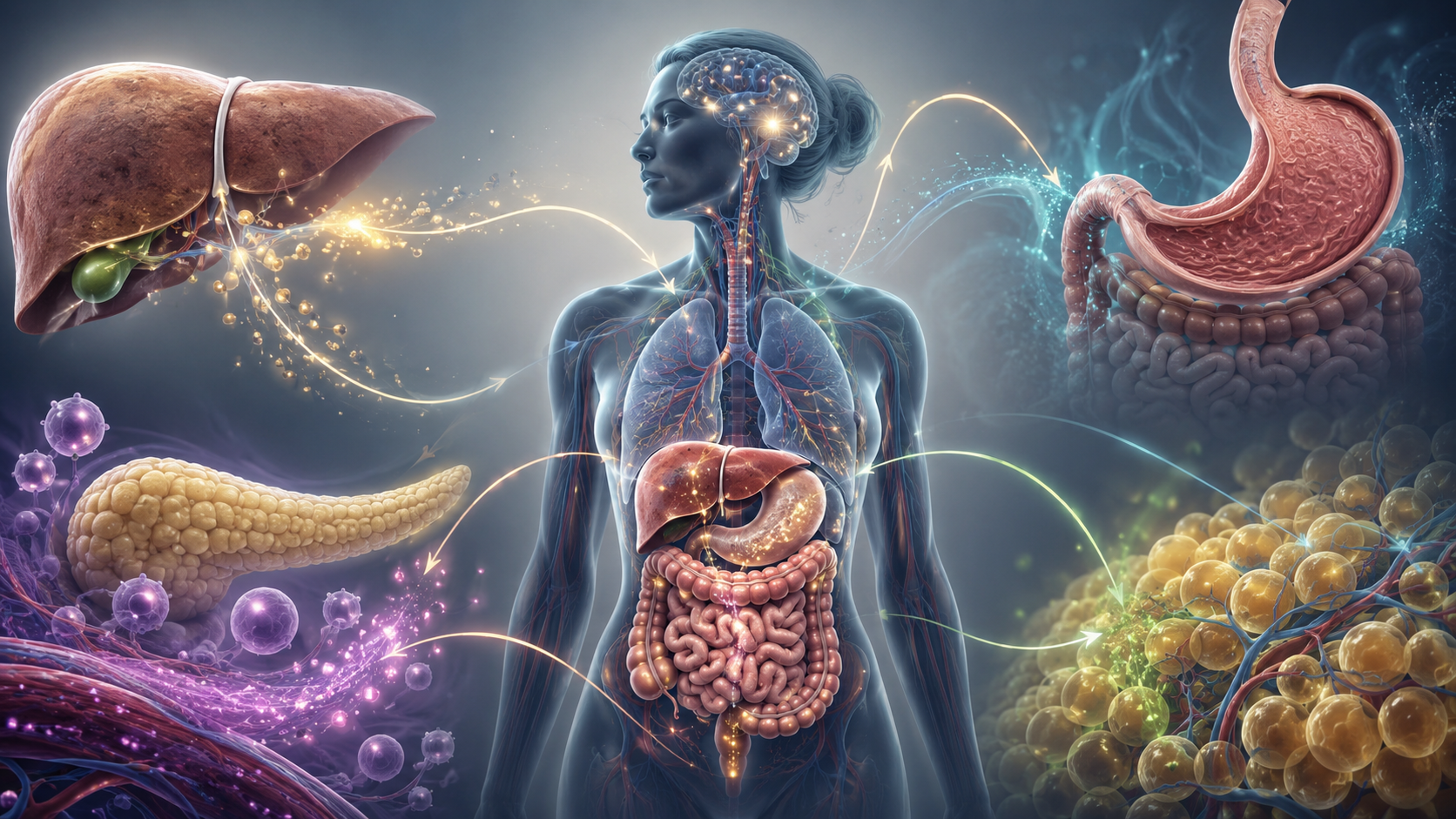
Metabolic-associated steatotic liver disease, known by the acronyms MASLD and, in its more severe inflammatory form, MASH, is one of the most prevalent and least treatable conditions of contemporary medicine. It begins with the accumulation of fat in hepatic cells, steatosis, and can progress to inflammation, fibrosis, and, in the most severe cases, cirrhosis.
The connection with metabolism is direct: fatty liver disease is considered the hepatic manifestation of metabolic syndrome. Insulin resistance, dyslipidemia, abdominal obesity, all of these factors converge on the liver, which accumulates triglycerides it cannot process at the necessary speed. The result is an overloaded organ that, for years or decades, works silently under adverse conditions.
Until recently, medicine’s answer was mainly behavioral: diet change, weight loss, exercise. Effective in theory, difficult in clinical practice. The only medication approved specifically for MASH is resmetirom (approved by the FDA in 2024), an isolated achievement after decades of frustrated attempts.
25% of the world’s adult population with fatty liver disease. Decades of frustrated pharmacological attempts. And then came the Phase 2 data of retatrutide.
The study that changed the conversation
The Phase 2a clinical trial conducted by Harrison and colleagues, published in Nature Medicine in 2024, investigated retatrutide specifically in participants with MASLD/MASH, a research population different from the obesity and diabetes studies that dominated the headlines until then.
The results were, in the terms of the scientific publication, notable. Participants at the highest doses presented an average reduction of 82% in liver fat measured by magnetic resonance, MRI-PDFF, the standard methodology for noninvasive quantification of hepatic steatosis. And, even more surprising: 90% of participants at those doses completely normalized liver fat in 48 weeks. They did not reduce it. They normalized it.
To contextualize what “normalization” means here: once liver fat returns to values within the range considered physiological, the liver recovers the capacity to operate without the chronic metabolic stress that characterizes MASLD. Whether this translates into reversal of fibrosis, the most advanced phase before cirrhosis, is one of the questions the research program still needs to answer. But the direction of the data, on its own, represents a qualitative leap.
90% of participants completely normalized liver fat. They did not reduce it, they normalized it. In 48 weeks.
Why retatrutide reaches the liver so differently
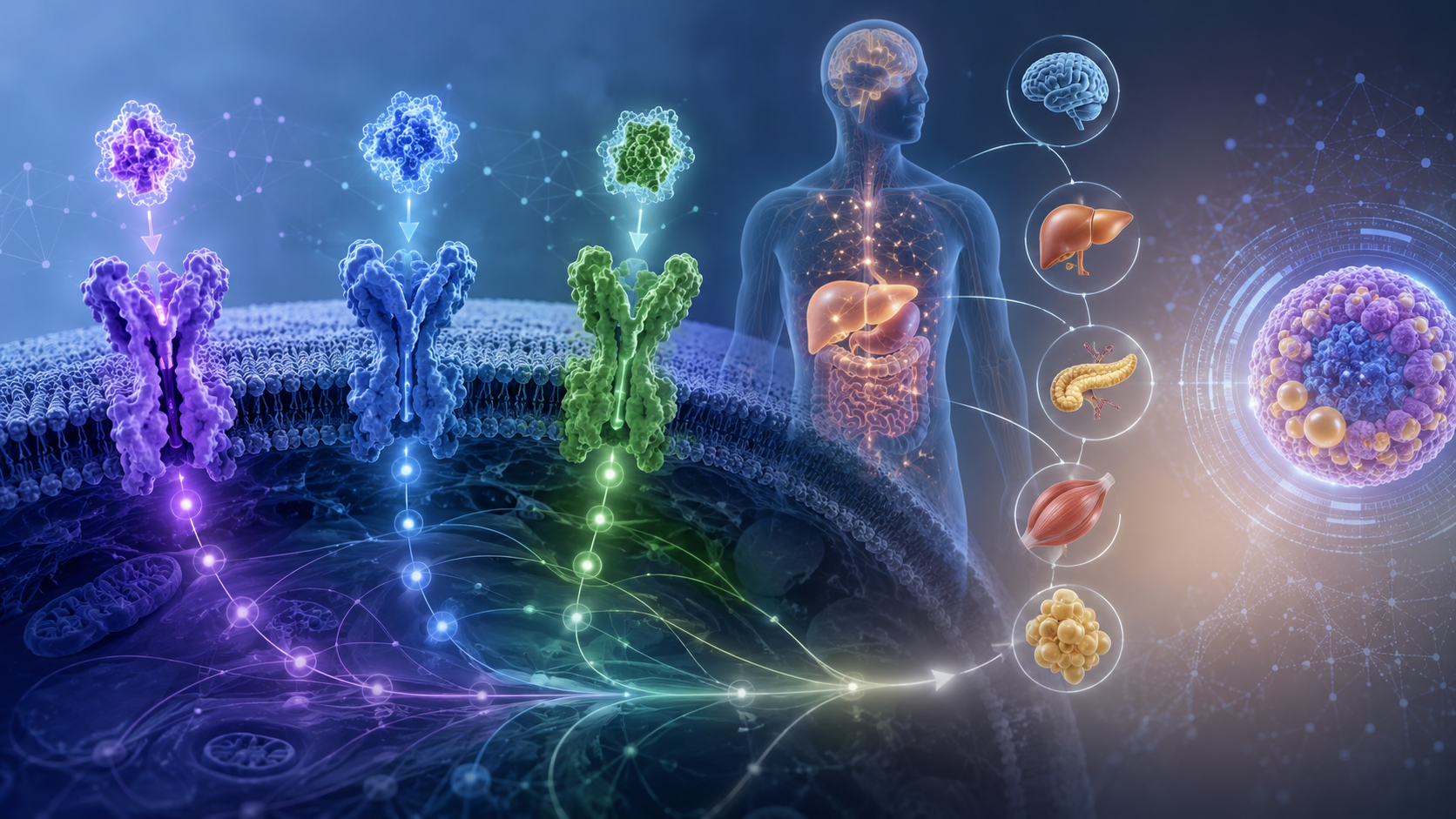
The mechanistic hypothesis is, in itself, one of the most interesting parts of the story. The liver is central to retatrutide’s biology for a structural reason: the glucagon receptor (GCGR) is expressed particularly densely in the liver. When activated, it regulates hepatic gluconeogenesis, the production of glucose from non-carbohydrate substrates, but it also stimulates fatty-acid oxidation.
In other words: the activation of GCGR by the glucagon component of retatrutide appears to put the liver in accelerated-burn mode. At the same time, the GLP-1R and GIPR components of the molecule reduce the input of new lipids to the liver, via reduction of de novo lipogenesis and improvement of peripheral insulin sensitivity. The result, in the studied models, is a combination of reduced fat entry into the organ and increased exit.
This convergence of distinct mechanisms acting on the same organ is what distinguishes retatrutide’s research profile in MASLD from any earlier approach. Mono-agonists act on one pathway. Dual agonists on two. Retatrutide, in the researchers’ hypothesis, coordinates three.
The elephant in the room: what is still open
It must be said clearly: the Harrison et al. study is a Phase 2a trial, designed to signal efficacy and explore safety, not to confirm definitive clinical outcomes. The number of participants, although sufficient to generate solid hypotheses, is not that of a confirmatory Phase 3 trial. The normalization of liver fat is a surrogate marker, relevant, but not equivalent to demonstrating reversal of fibrosis or reduction of long-term clinical outcomes such as cirrhosis and hepatic mortality.
The TRIUMPH Program, which conducts the Phase 3 studies of retatrutide, does not include, as of April 2026, a specific pivotal trial for MASLD/MASH among its principal studies. What exists are the published Phase 2 data, robust enough to put retatrutide on the map of this indication, insufficient to confirm a definitive clinical benefit. That distinction matters.
And, of course: the molecule has no regulatory approval for any indication. It is classified as RUO, Research Use Only. What the literature investigates is the mechanism and the potential; what regulation confirms (or not) is the therapeutic application. These are distinct steps, and neither replaces the other.
The liver as a central metabolic organ may be, paradoxically, where the most interesting retatrutide story is still going to unfold.
The frontier that opens
What researchers in hepatic biology, endocrinology, and metabolic pharmacology are following closely is this question: if retatrutide demonstrates this magnitude of effect on hepatic steatosis in a Phase 2 trial, what will the Phase 3 studies, with larger populations, longer follow-up, and more robust outcomes, reveal?
MASLD is a condition medicine has tried to treat pharmacologically for decades with modest results. If the Phase 2 data are confirmed at larger scale, retatrutide may open a line of research that goes well beyond weight metabolism, and place the triagonism of incretin receptors as a central hypothesis in the hepatic biology of the 21st century.
The liver, finally, may have found its pharmacological interlocutor. Science is still building the case. But the first data are the kind of thing that makes researchers think differently about the possible.