Mitochondrial Energy System

System Overview Energy at the Source. Research Into Mitochondrial Biology.
The Mitochondrial Energy System encompasses the molecular networks that govern how cells produce, regulate, and adapt their energy supply. Mitochondria are far more than ATP-generating organelles: they function as dynamic signaling hubs that communicate with the nucleus, regulate apoptosis, modulate oxidative stress, and integrate metabolic signals from the broader cellular environment. Research in this field investigates how disruptions in mitochondrial architecture and bioenergetics relate to aging, metabolic dysfunction, and tissue decline, and, conversely, how specific molecular interventions might influence these processes in controlled experimental models.


Core Mechanisms Four Research Axes in Mitochondrial Biology
The compounds in this system are investigated through four primary mechanistic frameworks. Each represents a distinct entry point into mitochondrial function.
NAD+ functions as both a metabolic coenzyme and a signaling substrate. Research investigates how its progressive decline with aging affects the activity of sirtuin deacylases (SIRT1-7), which regulate mitochondrial biogenesis, oxidative stress response, and genomic stability through PGC-1α coactivation and downstream transcriptional programs.
The architecture of the inner mitochondrial membrane, shaped by cardiolipin composition and cristae morphology, determines the efficiency of respiratory complex assembly and oxidative phosphorylation. Studies examine how targeted compounds influence this structural framework, ATP synthesis rates, and the cellular response to ischemic or oxidative challenge.
The estrogen-related receptor (ERR) family, acting in concert with PGC-1α, regulates the transcriptional programs that govern mitochondrial content and oxidative capacity in energy-demanding tissues. Research investigates synthetic ERR agonists as tools to pharmacologically recapitulate exercise-induced adaptive gene expression in preclinical models.
Mitochondrial-derived peptides (MDPs) such as MOTS-c are investigated as endogenous signals that translocate to the nucleus under metabolic stress, modulating gene expression through AMPK activation and antioxidant response element (ARE) pathways, a form of retrograde communication linking mitochondrial status to nuclear transcription.

Related Compounds Research Compounds in This System
Each compound is classified within the Mitochondrial Energy System by its primary mechanism of action. Compounds with broader biological activity are noted accordingly.
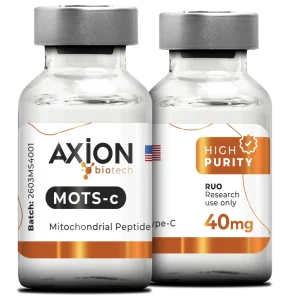
Encoded within the mitochondrial genome's 12S rRNA region. Investigated for its role in AMPK activation, retrograde nucleus signaling, and metabolic energy regulation in animal models and in vitro studies.
View Product
Essential coenzyme for oxidative phosphorylation and required substrate for sirtuins. Researched in the context of age-associated decline, mitochondrial biogenesis, and DNA repair pathway regulation.
View Product
Selectively accumulates at the inner mitochondrial membrane via cardiolipin interaction. Investigated across preclinical models and early clinical studies for its influence on respiratory complex function and ATP recovery under conditions of mitochondrial dysfunction. Note: AXION's compound is a research-grade (RUO) version and is not related to, nor a substitute for, any approved pharmaceutical product
View Product
Pathways & Biological Context Key Research Pathways
The following molecular pathways represent the primary mechanistic terrain investigated in this system. Individual compounds engage these pathways through distinct mechanisms.
- NAD+/SIRT1/PGC-1α axis, mitochondrial biogenesis and oxidative stress response
- AMPK (AMP-activated protein kinase), central cellular energy sensor
- ERRα/β/γ (Estrogen-Related Receptors), upstream transcriptional regulation of mitochondrial biogenesis
- Folate-AICAR-AMPK pathway, primary signaling axis of MOTS-c retrograde communication
- NAD+/SIRT1/PGC-1α axis, mitochondrial biogenesis and oxidative stress response
- AMPK (AMP-activated protein kinase), central cellular energy sensor
- ERRα/β/γ (Estrogen-Related Receptors), upstream transcriptional regulation of mitochondrial biogenesis
- Folate-AICAR-AMPK pathway, primary signaling axis of MOTS-c retrograde communication

Related Articles - Research Library Explore the Science Behind This System
The Research Library provides in-depth editorial coverage of the mechanisms, evidence, and investigative directions relevant to this system. Each article connects to one or more related compounds in the AXION catalog.
Scientists discovered that physical exercise triggers the production of a molecule called MOTS-c directly within the mitochondria. Now, researchers are investigating what happens when that signal is amplified, or when it fades with age.
View related research libraryThe Level That Falls with Age, and What Science Is Investigating
View related research libraryOne of the most unsettling discoveries in recent cell biology: mitochondria do not merely produce energy, they send messages straight to the nucleus of the cell. MOTS-c is the messenger. And what it says changes how genes are expressed.
View related research libraryInside every cell of your body there is a molecule that governs energy, repairs DNA, and tells your cells how much time they have. Research on NAD+ may be pointing to one of the most fundamental questions in human biology.
View related research libraryThe War Inside Every Cell, and NAD+ in the Crossfire
View related research libraryThe Guardians of the Genome Need Permission to Act, and NAD+ Is the Key
View related research libraryHow a synthetic tetrapeptide traveled through decades of science and reached Phase III clinical trials for one of the most difficult heart conditions to treat, and what that reveals about the future of mitochondrial research.
View related research libraryWhy the world's most serious researchers stopped looking at DNA and began studying the cell's power plant, and what a synthetic tetrapeptide has to do with it.
View related research libraryThe scientific story of how two researchers created a class of molecules with intrinsic mitochondrial selectivity, and why that discovery took two decades to be taken seriously by the pharmaceutical world.
View related research libraryAll compounds listed in this system are classified as Research Use Only (RUO). They are not approved for therapeutic, diagnostic, or clinical use in humans or animals. AXION does not make therapeutic claims of any kind. Access to compounds is available through AXION's structured access model.