It was 1996. Researchers at the Penn State College of Medicine, in Hershey, Pennsylvania, were mapping genes capable of suppressing the spread of cancer cells, the metastases. In the midst of this work, they identified a gene on chromosome 1 with the capacity to brake tumor invasion in malignant melanoma. They named the product of that gene Metastin. The name of the gene, KISS1, was a good-humored tribute to the city of Hershey, famous for Hershey’s Kisses chocolates.
For years, KISS1 was studied exclusively in this oncological context. It was a piece of a puzzle about how the body tries to contain tumors. No one, at that moment, suspected the molecule had a second life, and that this second life would be far more central to human biology than any antitumor role.
The turn happened in 2003. Two independent groups of researchers, one led by Nicolas de Roux in Paris, and another by Stephanie Seminara in Boston, published their findings almost simultaneously. Both had found patients with one thing in common: a mutation in the receptor of Metastin, called GPR54. And what that mutation caused was radical.
The carriers simply did not go through puberty.
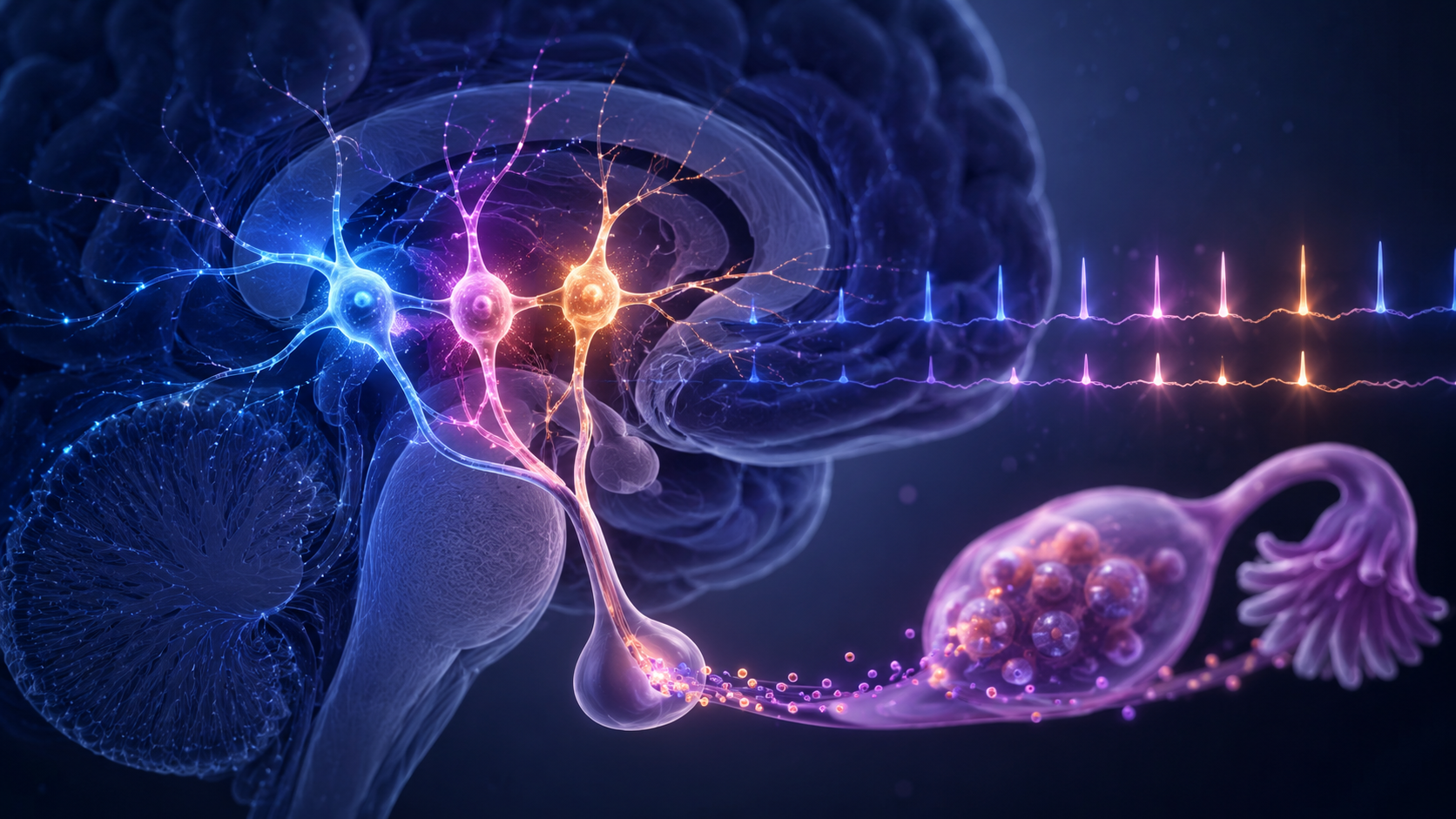
Without the functional signaling between Metastin, now renamed kisspeptin, and its receptor, the hormonal axis that regulates reproduction was never activated. The patients reached adulthood with their reproductive organs in the state of a prepubescent child. There was no development, no menstrual cycle, no testosterone production. The reproductive system simply remained silent.
The discovery was published in the New England Journal of Medicine and redefined reproductive neuroendocrinology in a single stroke. Kisspeptin was not just a curious molecule from oncology. It was the master switch of the entire human reproductive system, the signal that, in the hypothalamus, authorizes the body to begin the hormonal cascade of reproduction.
Today, the kisspeptin-KISS1R system is investigated on multiple fronts: as a tool to study reproductive disorders, as a model to understand the onset of puberty, and as a point of entry for research on fertility. The trajectory of KISS1, from tumor suppressor to central regulator of human reproduction, is one of the best available examples of how science finds answers where it least expects them.