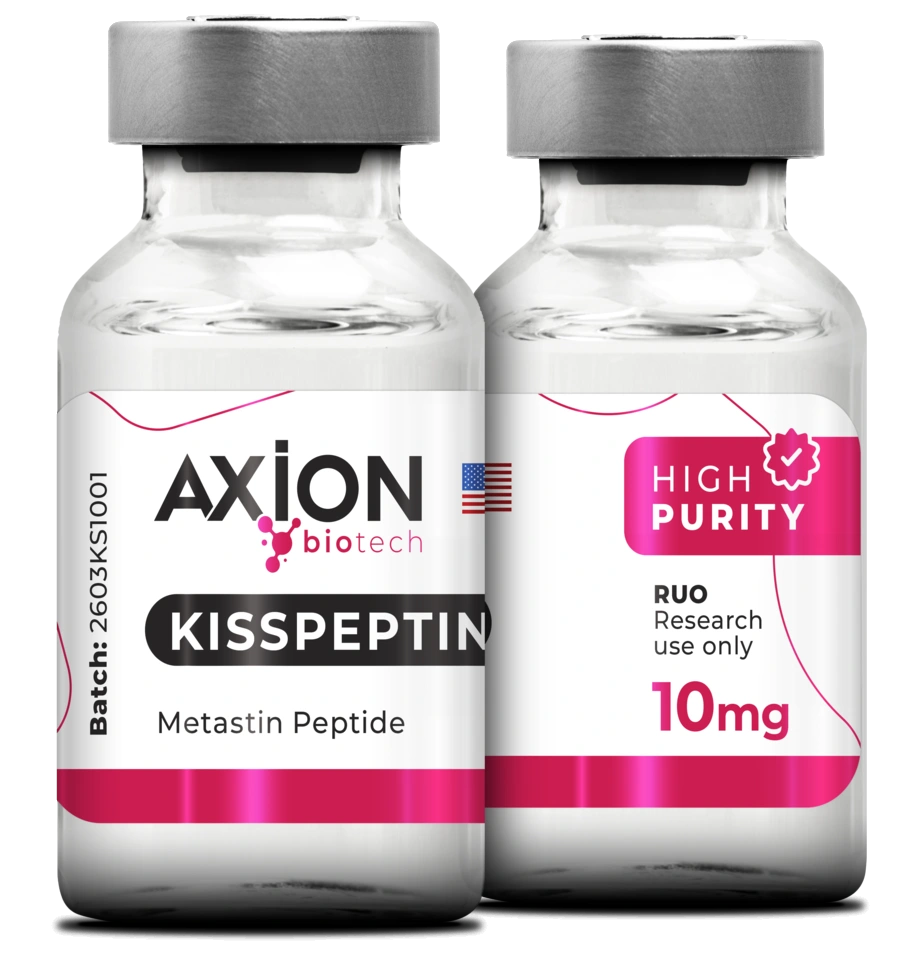
KISSPEPTIN
Access to the catalog is structured — not open by default.
-
SystemReproductive & Sexual Health System
-
TypeEndogenous peptide — RFamide family
-
IsoformsKP-10, KP-13, KP-14, KP-54 (gene KISS1)
-
CAS (KP-10)374675-21-5
-
Formula (KP-10)C₆₃H₈₃N₁₇O₁₄
-
Mol. weight (KP-10)1,302.45 Da
-
FormLyophilized vial
-
Purity>98% by HPLC
-
StatusActive

KISSPEPTIN Overview
Kisspeptin is a family of endogenous peptides encoded by the KISS1 gene (chromosome 1q32), produced by proteolytic cleavage of a 145-amino acid precursor. The biologically active isoforms, KP-10, KP-13, KP-14, and KP-54, all share the same C-terminal Arg-Phe-NH₂ motif characteristic of the RFamide peptide family, and act through the same receptor: KISS1R (GPR54), a seven-transmembrane G-protein-coupled receptor predominantly expressed in hypothalamic GnRH neurons.
In the context of reproductive biology, kisspeptin occupies a critical position upstream of the hypothalamic-pituitary-gonadal (HPG) axis. Its primary documented role in the literature is the regulation of pulsatile GnRH secretion, the fundamental rhythm that governs gonadotropin release (LH and FSH) from the pituitary and, consequently, gonadal steroidogenesis. The discovery that loss-of-function mutations in GPR54 caused complete absence of pubertal development in both humans and mice (Seminara et al., 2003) established kisspeptin-KISS1R signaling as an obligatory, rather than merely modulatory, component of mammalian reproduction.
Among the isoforms, KP-10 (Kisspeptin-10) is the most widely used in research settings due to its structural simplicity (10 amino acids) and potent KISS1R activation (EC₅₀ ≈ 2.8 nM in hypothalamic electrophysiology models). KP-54 offers significantly longer plasma half-life (27.6 ± 1.1 min versus 3.8 ± 0.3 min for KP-10) and has been the primary isoform studied in Phase I/II human clinical research. AXION supplies the KP-10 isoform as a research-grade (RUO) lyophilized compound.


KISSPEPTIN Research Directions
The published literature on kisspeptin spans more than two decades and encompasses neuroendocrinology, reproductive medicine, clinical pharmacology, and oncology. Below is an overview of the principal research areas documented in preclinical and clinical studies.
- HPG axis regulation — investigation of kisspeptin as the primary upstream regulator of pulsatile GnRH secretion in hypothalamic models; KNDy neuron circuit dynamics
- Puberty onset research — kisspeptin as central trigger of reproductive maturation; gain- and loss-of-function genetic models (Kiss1-/- and Gpr54-/- mice)
- Hypogonadotropic hypogonadism — Phase I/II trials investigating kisspeptin-induced LH/FSH release in patients with IHH and hypothalamic amenorrhea
- Assisted reproduction — Phase II studies exploring KP-54 as an oocyte maturation trigger in IVF cycles, particularly in patients at high risk for ovarian hyperstimulation syndrome (OHSS)
- Sexual desire and neural processing — fMRI studies (Comninos et al., 2022/2023) examining kisspeptin-mediated modulation of brain activity in response to sexual stimuli in HSDD models
- Neuroendocrine pulsatility research — subcutaneous pulsatile kisspeptin administration as a probe for GnRH neuronal function and HPG axis integrity
- Metabolic regulation of reproduction — interactions between kisspeptin neurons and energy-sensing signals (leptin, ghrelin) in nutritional state-mediated reproductive suppression
- Cancer biology — original KISS1 discovery context: metastasis suppressor activity in melanoma and other cancers; ongoing investigation of KISS1/KISS1R system in tumor progression
Kisspeptin binds KISS1R with high affinity (Ki ≈ 2.33 nM for KP-10). Receptor activation couples to Gq/11, triggering PLC-mediated hydrolysis of PIP₂ into IP₃ and DAG, initiating Ca²⁺ mobilization from the ER and PKC activation.
Intracellular Ca²⁺ release activates non-selective cation channels (TRPC), causing sustained depolarization of GnRH neurons and increased action potential firing rate. Effect duration: partial recovery up to 30 min post-stimulation (Zhang et al., 2008).
Kisspeptin inhibits A-type K⁺ currents and inward rectifier K⁺ channels (Kir 6.2 / GIRK), extending neuronal excitability. This mechanism prolongs the activation window of GnRH neurons beyond the initial Ca²⁺ transient.
KISS1R activation engages MAP kinase cascades (ERK1, ERK2; weaker p38 MAPK), contributing to transcriptional regulation and downstream signaling integration in hypothalamic neurons.
Activated GnRH neurons release GnRH in discrete pulses into the portal circulation, stimulating anterior pituitary gonadotrophs to secrete LH and FSH, which in turn regulate gonadal steroidogenesis and gametogenesis.
In the infundibular nucleus, kisspeptin neurons co-express Neurokinin B (NKB) and Dynorphin (Dyn). NKB stimulates and Dyn inhibits kisspeptin secretion, creating an endogenous pacemaker for GnRH pulse frequency.

KISSPEPTIN Quality & Traceability
Every AXION compound is subject to analytical verification before release. Purity and traceability are not marketing attributes — they are part of the integrity of the research itself.
-
Certificate of Analysis
Available per lot on request.
-
Lot Traceability
Each vial carries a unique lot number linked to its full analytical record.
-
QR Verification
QR code on packaging links directly to the COA for that specific lot.
-
HPLC Verified
>98% purity per lot. Verified by HPLC + Mass Spectrometry.
Learn more about our verification process: Quality & Testing

Related Articles - Research Library Explore the Science Behind This System
The Research Library provides in-depth editorial coverage of the mechanisms, evidence, and investigative directions relevant to this system. Each article connects to one or more related compounds in the AXION catalog.
Kisspeptin is supplied by AXION Biotech exclusively for research purposes. This compound is not approved by the FDA, ANVISA, or any regulatory agency for human or veterinary use. No therapeutic claims are made or implied.
All scientific data referenced on this page derives from preclinical (animal / in vitro) models or Phase I/II clinical studies (small n, short-term) unless explicitly stated otherwise. Extrapolation from preclinical findings to human physiology is not supported by current evidence without appropriate qualification.