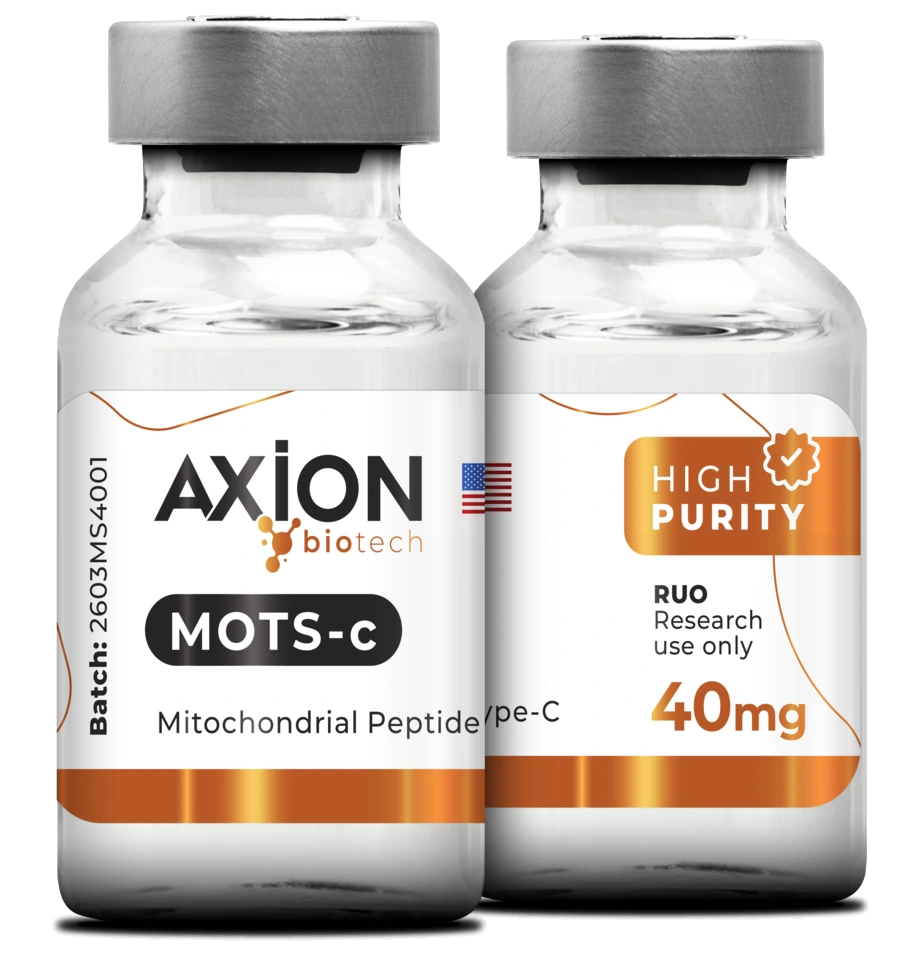
MOTS-c
-
SystemMitochondrial Energy System
-
TypeMitochondrial-encoded peptide — 16 amino acids
-
CAS1627580-64-6
-
FormulaC₁₀₁H₁₅₂N₂₈O₂₂S₂
-
Mol. weight~2,174.6 Da
-
SequenceMRWQEMGYIFYPRKLR
-
FormLyophilized vial
-
Purity≥97% by RP-HPLC; frequently ≥99%
-
StatusActive

MOTS-c Overview
MOTS-c (Mitochondrial Open Reading Frame of the 12S rRNA Type-C) is a 16-amino acid peptide encoded not by the nuclear genome, but by the mitochondrial genome, specifically within the 12S rRNA gene. This origin is scientifically unusual: MOTS-c is the only compound in AXION’s catalog derived from mitochondrial DNA, placing it in a distinct class of molecules known as Mitochondrial-Derived Peptides (MDPs). It belongs to AXION’s Mitochondrial Energy System, a research compound cluster organized around signaling pathways associated with mitochondrial function, energy homeostasis, and metabolic regulation.
The published literature characterizes MOTS-c as a mitokine, a signaling peptide released by mitochondria with paracrine and endocrine activity beyond the cell of origin. Its primary investigated mechanism involves inhibition of the folate cycle and de novo purine biosynthesis, leading to intracellular accumulation of AICAR, an endogenous activator of AMPK (AMP-Activated Protein Kinase). AMPK activation downstream coordinates a broad metabolic program, including glucose uptake, fatty acid oxidation, and mitochondrial biogenesis. The field has been led primarily by researchers at the USC Leonard Davis School of Geroscience, including Changhan Lee and Pinchas Cohen.
A distinguishing property of MOTS-c is its capacity for nuclear translocation. Under metabolic stress conditions, MOTS-c migrates from mitochondria to the nucleus, where it directly regulates gene expression, including genes containing Antioxidant Response Elements (ARE) and interactions with the NRF2 transcription factor. This retrograde mitochondrial-to-nuclear signaling represents one of the most investigated mechanisms of inter-organelle communication in current mitochondrial biology.


MOTS-c Research Directions
The published literature on MOTS-c spans metabolic biology, aging science, and exercise physiology. Below is an overview of the principal research areas documented in preclinical and observational studies.
- Metabolic homeostasis and insulin resistance — studies in dietary-induced obesity (DIO) and age-induced insulin resistance models; primary signaling via folate cycle inhibition and AMPK activation (Lee et al., Cell Metabolism, 2015 — preclinical)
- Nuclear translocation and gene regulation — MOTS-c as a retrograde mitochondrial-to-nuclear signal under metabolic stress; regulation of ARE-containing genes and NRF2 interaction (Kim et al., Cell Metabolism, 2018 — in vitro, mechanistic)
- Age-related physical decline — intermittent MOTS-c treatment in late-life mouse models showed effects on physical capacity and muscle homeostasis; observational data in humans shows exercise-induced endogenous expression (Reynolds et al., Nature Communications, 2021)
- Endogenous MOTS-c and aging — plasma levels of endogenous MOTS-c decline with age in humans across three age groups (n=75 total, observational — not interventional)
- White-to-brown adipose tissue conversion — MOTS-c investigated for its role in adipose phenotype regulation via AMPK downstream effects in preclinical models
Inflammatory modulation — reduction of pro-inflammatory factor expression observed in preclinical models as a downstream effect of AMPK activation - Mitochondrial-nuclear communication — MOTS-c as a molecular mediator of retrograde signaling; one of the most studied mechanisms of inter-organelle crosstalk in current biology
- Exercise biology — MOTS-c characterized as an ‘exercise-induced mitokine’: endogenous levels in skeletal muscle and circulation increase with physical activity (observational in humans)
Primary mechanism: MOTS-c inhibits the folate cycle and de novo purine biosynthesis, leading to AICAR accumulation. AICAR is an endogenous AMPK activator, triggering downstream metabolic reprogramming — glucose uptake, fatty acid oxidation, mitochondrial biogenesis.
AMPK activation downstream upregulates PGC-1α, the master transcriptional coactivator of mitochondrial biogenesis and oxidative metabolism. Investigated in models of age-induced and diet-induced metabolic decline.
Under metabolic stress, MOTS-c translocates from mitochondria to the nucleus. In the nucleus, it regulates genes containing Antioxidant Response Elements (ARE) and interacts with NRF2 — a master transcription factor of cellular oxidative defense.
MOTS-c functions as a retrograde signaling molecule: mitochondria communicate metabolic state to the nucleus via MOTS-c translocation. One of the most characterized mechanisms of inter-organelle communication in current mitochondrial biology.
AMPK activation downstream of MOTS-c is associated with reduced expression of pro-inflammatory factors in preclinical models. Mechanism consistent with known AMPK anti-inflammatory effects; specific inflammatory targets under ongoing investigation.
Preclinical models indicate MOTS-c involvement in adipose tissue phenotype regulation, consistent with AMPK's documented role in thermogenic gene expression and mitochondrial content in adipocytes.

MOTS-c Quality & Traceability
Every AXION compound is subject to analytical verification before release. Purity and traceability are not marketing attributes — they are part of the integrity of the research itself.
-
Certificate of Analysis
Available per lot on request.
-
Lot Traceability
Each vial carries a unique lot number linked to its full analytical record.
-
QR Verification
QR code on packaging links directly to the COA for that specific lot.
-
HPLC Verified
≥97% purity per lot; frequently ≥99%. Verified by RP-HPLC + Mass Spectrometry.
Learn more about our verification process: Quality & Testing

Related Compounds Compounds in the Mitochondrial Energy System
All compounds below belong to the same biological system as MOTS-c. Each is supplied as an RUO research compound.
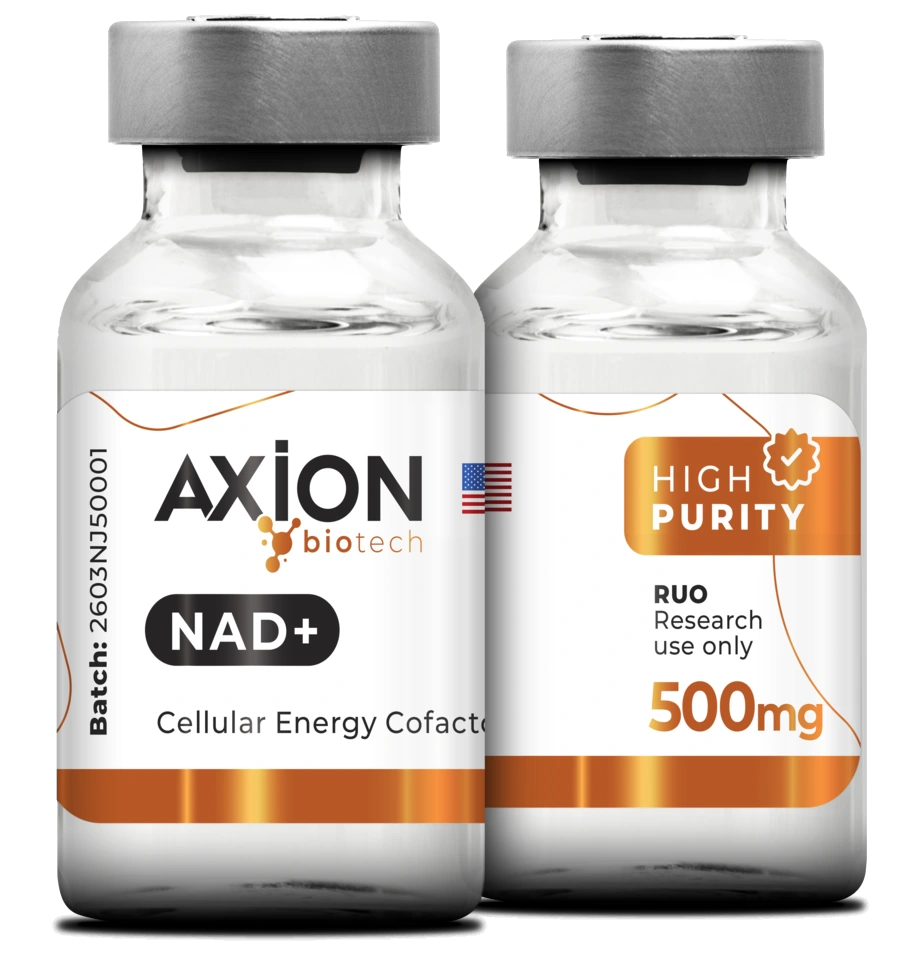
NAD+
NAD+ (Nicotinamide Adenine Dinucleotide) is an endogenous coenzyme present in every living cell, functioning as the central carrier of electrons in cellular energy metabolism. As a member of AXION's Mitochondrial…
View molecule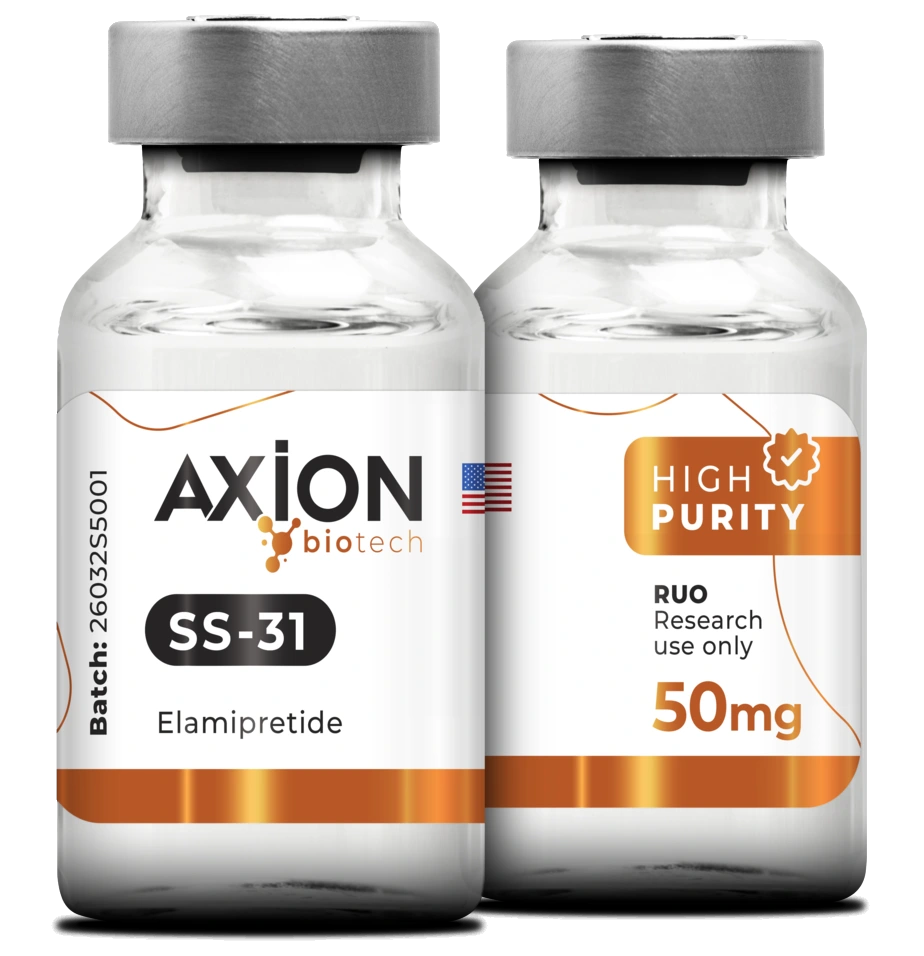
SS-31 (Elamipretide)
SS-31 is a synthetic tetrapeptide belonging to the Szeto-Schiller class, a family of aromatic-cationic peptides developed for their intrinsic mitochondrial selectivity. Also known as Elamipretide or MTP-131, the compound is…
View molecule
Related Articles - Research Library Explore the Science Behind This System
The Research Library provides in-depth editorial coverage of the mechanisms, evidence, and investigative directions relevant to this system. Each article connects to one or more related compounds in the AXION catalog.
MOTS-c is supplied by AXION Biotech exclusively for research purposes. This compound is not approved by the FDA, ANVISA, or any regulatory agency for human or veterinary use. No therapeutic claims are made or implied. All scientific data referenced on this page derives from preclinical (animal / in vitro) models unless explicitly stated otherwise. Observational human data reflects endogenous MOTS-c expression and is not evidence of therapeutic efficacy of exogenous administration.